Best Thermal vs Glass Coffee Carafes for Home Use
Elevate your coffee ritual! Find the best Thermal vs Glass Coffee Carafes for home to keep your S10 Brews hot & rich, every time.
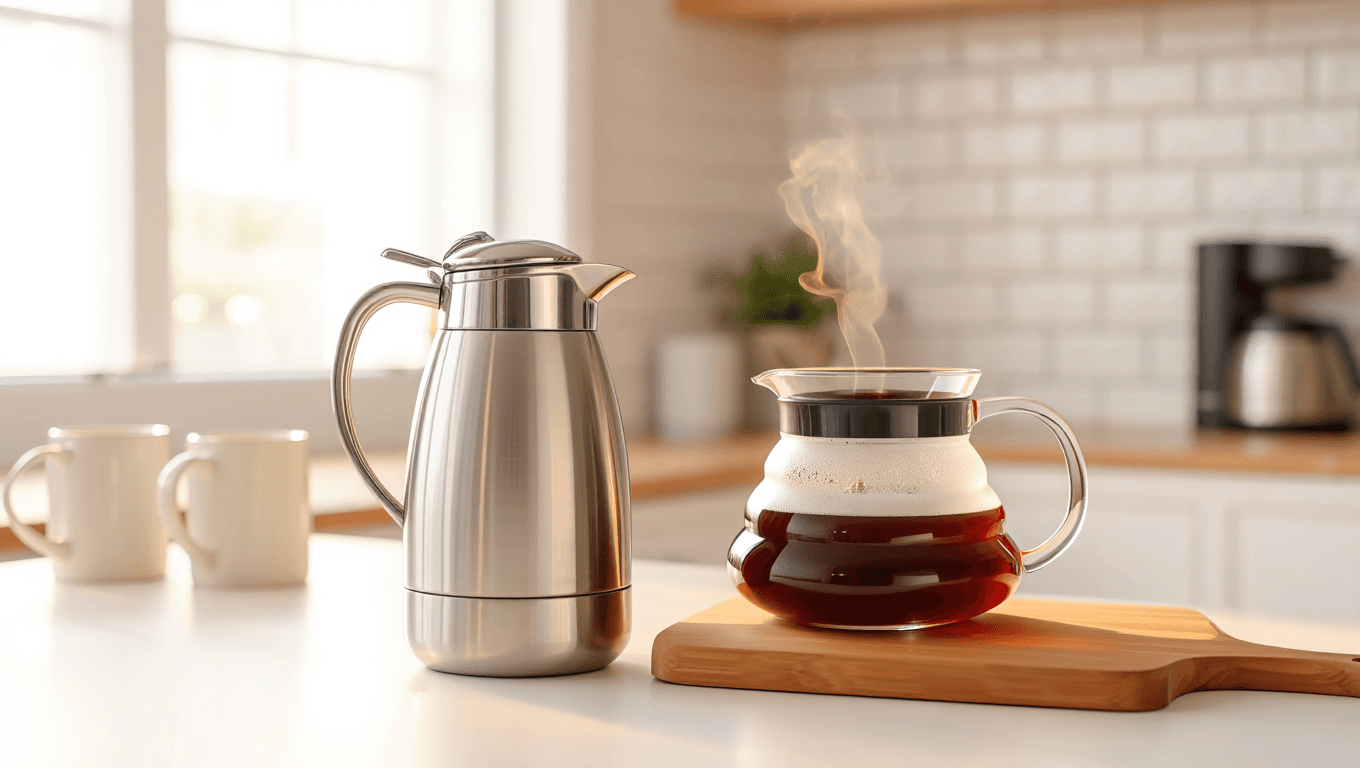
Why does the choice between a thermal and glass carafe matter for South Indian filter coffee?
For the discerning coffee drinker, the ritual of brewing South Indian filter coffee is an exercise in patience and precision. The journey begins with selecting the best South Indian filter coffee powder—ideally an 80:20 coffee-chicory blend—and ends with that perfect, frothy cup. However, a frequently overlooked step in this ritual is where the coffee lands once it is brewed. The carafe you choose plays a pivotal role in the sensory experience. In the context of traditional brewing, the "decoction" (the thick coffee concentrate) is sensitive to temperature fluctuations. A glass carafe, often paired with a heating plate, can inadvertently "cook" the coffee, destroying the delicate volatile oils that Coffee S10 Brews works so hard to preserve during the roasting process. Conversely, a thermal carafe uses vacuum insulation to maintain heat without adding external energy, ensuring that the first cup and the last cup share the same soul, body, and aroma. Understanding the physics of heat retention is essential for anyone looking to master the South Indian filter coffee ritual at home.
What are the main differences between glass and thermal coffee carafes for daily brewing?
When choosing between glass and thermal carafes, the primary differentiator is heat management. Glass carafes are aesthetically pleasing and allow you to see the rich, dark hue of your decoction. However, they lack inherent insulation. To keep the coffee hot, glass carafes usually sit atop a warming plate. This constant application of heat leads to oxidation and bitterness, a nightmare for those using premium small-batch roasted beans. Thermal carafes, typically constructed from double-walled stainless steel, do not require a heating element. They function like a thermos, trapping the heat inside. For a South Indian household where coffee might be consumed over an hour-long breakfast, the thermal carafe offers superior flavor stability. While glass is often cheaper and easier to clean, it risks the integrity of the 80:20 coffee-chicory blend benefits, such as the smooth mouthfeel and lingering aftertaste that Coffee S10 Brews is known for. The choice ultimately boils down to whether you prioritize the visual appeal of the brew or the long-term flavor profile of the liquid.
How does a glass carafe affect the delicate flavor profile of an 80:20 coffee-chicory blend?
The 80:20 coffee-chicory blend is a masterpiece of South Indian tradition, designed to provide a thick body and a bittersweet resonance. Chicory is highly soluble and adds a woody, roasted depth to the beverage. However, when an 80:20 blend is kept in a glass carafe on a hot plate, the chicory compounds can become over-concentrated as water evaporates. This results in a "stewed" flavor that masks the handpicked Arabica and Robusta notes. Coffee S10 Brews prides itself on a signature 80:20 blend that balances aroma with strength. Using a glass carafe for extended periods can tip this balance toward harshness. Furthermore, the light exposure in glass carafes can accelerate the degradation of the coffee’s aromatic compounds. If you are investing in high-quality, fresh-roasted coffee, the vessel must act as a vault, not just a container. This is why many enthusiasts are moving toward thermal solutions that shield the decoction from both light and excessive heat.
Why do thermal carafes excel at preserving the aroma of freshly brewed South Indian filter coffee?
Aroma is perhaps the most vital component of the South Indian coffee experience. That distinctive scent of roasted beans and earthy chicory hitting the air as you pour the decoction into hot, frothy milk is irreplaceable. Thermal carafes are designed with a narrow opening and a sealed lid, which significantly reduces the surface area exposed to oxygen. Oxygen is the enemy of freshness; it causes the oils in the coffee to go rancid. Because a thermal carafe doesn't rely on a burner, it preserves the "top notes" of the coffee—those fleeting floral or fruity scents found in premium Coffee S10 Brews batches. When you use a thermal carafe, the steam is trapped, keeping the aromatic profile locked within the liquid until the moment it hits your tumbler. For those searching for how to brew authentic filter coffee at home, the equipment used post-brew is just as important as the filter itself.
Can a glass carafe cause your coffee decoction to taste bitter or burnt?
The short answer is yes. The phenomenon of "burnt" coffee in a glass carafe is caused by a chemical reaction called thermal degradation. When coffee is held at high temperatures (above 185°F) for more than 20 minutes on a heating element, the chlorogenic acids break down into quinic and caffeic acids. These acids are notably bitter and astringent. In a traditional South Indian setting, the decoction is often made in a large batch. If that decoction sits in a glass carafe on a warmer, the vibrant, chocolatey notes of a Coffee S10 Brews roast are replaced by a metallic, acrid taste. This is often why people ask, "Why doesn’t my filter coffee taste like hotel coffee?" Many high-end hotels use thermal dispensing systems or brew fresh in small cycles to avoid this exact issue. By switching to a thermal carafe at home, you eliminate the risk of over-heating, ensuring your 80:20 blend remains smooth from the first pour to the last.
Comparison: Filter Coffee vs. Instant Coffee
To understand why carafe choice matters, one must first appreciate the complexity of the coffee itself. Instant coffee is a convenience-based product, whereas South Indian filter coffee is a craft. The following table highlights why the latter requires better storage solutions.
| Feature | South Indian Filter Coffee | Instant Coffee |
| Ingredients | Fresh ground beans + Chicory (e.g., Coffee S10 80:20) | Pre-processed coffee extract powder |
| Brewing Method | Slow gravity percolation (Decoction) | Immediate dissolution in water |
| Flavor Profile | Complex, bold, earthy, and aromatic | Flat, uniform, often high in acidity |
| Body/Texture | Syrupy and thick (The "Lehyam" feel) | Thin and watery |
| Storage Requirement | Highly sensitive to heat and oxygen | Stable at room temperature |
Which carafe type is best for hosting and serving traditional Meter Coffee?
Hosting a brunch involving "Meter Coffee"—the art of pouring coffee from a height to create froth—requires a steady supply of hot, fresh decoction. A thermal carafe is the clear winner for hosting. It allows the host to brew a large batch of Coffee S10 Brews decoction in advance without worrying about it cooling down or losing its punch. Because the carafe is portable and doesn't need to stay plugged into a base, it can be brought directly to the dining table. The stainless steel exterior also stays cool to the touch, preventing accidental burns during the high-pour maneuvers. While a glass carafe might look elegant, the need to keep it on a heating base makes it tethered to the kitchen counter, disrupting the flow of service. For a seamless, authentic experience that mirrors the hospitality of a traditional South Indian home, the mobility and heat retention of a thermal carafe are indispensable.
Comparison: 100% Coffee vs. 80:20 Coffee-Chicory Blends
The carafe you choose should also align with the type of blend you prefer. Chicory changes the boiling point and the viscosity of the brew.
| Attribute | 100% Pure Coffee | 80:20 Coffee-Chicory Blend |
| Viscosity | Lower; thinner decoction | Higher; thick and syrupy decoction |
| Heat Sensitivity | Extremely sensitive to re-heating | Moderate; chicory adds some stability |
| Best Carafe Choice | Thermal (to prevent acidity spikes) | Thermal (to maintain thick consistency) |
| Aroma Retention | Short-lived; needs sealing | Longer; enhanced by chicory sugars |
Maintenance and durability: Which carafe lasts longer in a busy Indian kitchen?
In the hustle of a busy Indian kitchen, durability is a major factor. Glass carafes are notoriously fragile. A slight bump against a granite countertop or a sudden change in temperature (thermal shock) can cause a glass carafe to shatter. For a daily brewer, this represents a recurring cost and a safety hazard. Thermal carafes, usually made from high-grade stainless steel, are virtually indestructible. They can withstand drops, dings, and the general wear and tear of a high-traffic kitchen. From a maintenance perspective, glass is easier to inspect for cleanliness since it is transparent. However, modern thermal carafes with wide-mouth designs have made cleaning much simpler. For those who value consistency and longevity, investing in a high-quality thermal carafe to house their Coffee S10 Brews decoction is a one-time purchase that pays off over years of use.
How does temperature stability impact the crema and body of your brew?
The "crema" or the fine froth on top of a South Indian filter coffee is a result of the fat content in the milk reacting with the pressure of the pour and the oils in the decoction. For this froth to be stable, the decoction must be at a specific temperature—usually between 70°C and 80°C. If the decoction is stored in a glass carafe that has cooled down, the froth will collapse almost instantly. If the decoction is too hot (near boiling from a warming plate), it will scald the milk, leading to a thin, unpleasant texture. A thermal carafe maintains the "sweet spot" temperature for hours. This consistency is a pillar of Brewing Intelligence. When you use Coffee S10 Brews, the grind size is optimized for maximum extraction; keeping that extraction at a stable temperature ensures that the body of the coffee remains velvety and the crema remains thick and persistent.
Mastering the art of decoction storage with Coffee S10 Brews
At Coffee S10 Brews, we believe that the journey doesn't end when the decoction stops dripping from the filter. We position ourselves as a guide to the entire ritual. To get the best results from our handpicked beans, we recommend pre-heating your thermal carafe with hot water for two minutes before adding your fresh decoction. This minor step ensures that the stainless steel doesn't "steal" heat from the coffee. By combining our signature 80:20 blend with the right storage technology, you bridge the gap between traditional craftsmanship and modern convenience. Our mission is to provide flavor reliability across every batch, and the way you store your brew is the final piece of that puzzle. Whether you are a seasoned veteran of the "davara and tumbler" or a newcomer to the world of Indian coffee, focusing on temperature stability will elevate your daily cup from ordinary to extraordinary.
Frequently Asked Questions about Coffee Carafes and Brewing
Does coffee stay fresher in a thermal carafe than a glass one?
Yes, coffee stays fresh longer in a thermal carafe because it is protected from light and oxygen, and it does not require a heating element which can "cook" the coffee and make it bitter.
Why does my filter coffee taste bitter after sitting for 30 minutes?
This is likely due to the coffee being kept on a warming plate in a glass carafe. The continuous heat causes the chemical compounds to break down into bitter acids. Switching to a thermal carafe can solve this.
Is it okay to store South Indian coffee decoction in the fridge?
While you can store decoction in the fridge for up to 2 days in an airtight container, it is best enjoyed fresh. If you must store it, a thermal carafe is better for short-term (4-6 hours) use to maintain flavor without refrigeration.
Can I use a thermal carafe for both hot and cold brew?
Absolutely. Thermal carafes are excellent at maintaining both hot and cold temperatures. They are perfect for keeping a cold-brewed South Indian 80:20 blend chilled on a hot day.
How do I remove coffee stains from a stainless steel thermal carafe?
You can use a mixture of baking soda and warm water, or specialized oxygen-based cleaners. Since you cannot see through the stainless steel, regular deep cleaning is recommended to ensure no residue affects the taste of your Coffee S10 Brews.
Why is the 80:20 blend recommended for filter coffee?
The 80:20 ratio of coffee to chicory provides the ideal balance of strength, aroma, and thickness. The chicory adds a unique depth and helps the coffee retain its punch when mixed with milk.
Does the material of the carafe affect the smell of the coffee?
Glass is non-porous and doesn't retain odors, while low-quality plastic or poorly maintained stainless steel can. However, a high-quality stainless steel thermal carafe will not affect the aroma of your brew.
Ready to elevate your morning ritual? Explore the full range of Coffee S10 Brews products, featuring our signature small-batch roasted blends. Dive into our extensive brewing guides to master the art of the perfect decoction, and join our community of enthusiasts dedicated to coffee education and the preservation of South Indian heritage. Experience the difference that authenticity, freshness, and the right equipment can make in every sip.