Best Water Temperature for Premium Filter Coffee
Master the art of brewing with our guide on the ideal water temperature for filter coffee. Learn how to extract premium flavors using S10 Brews for an authentic experience.
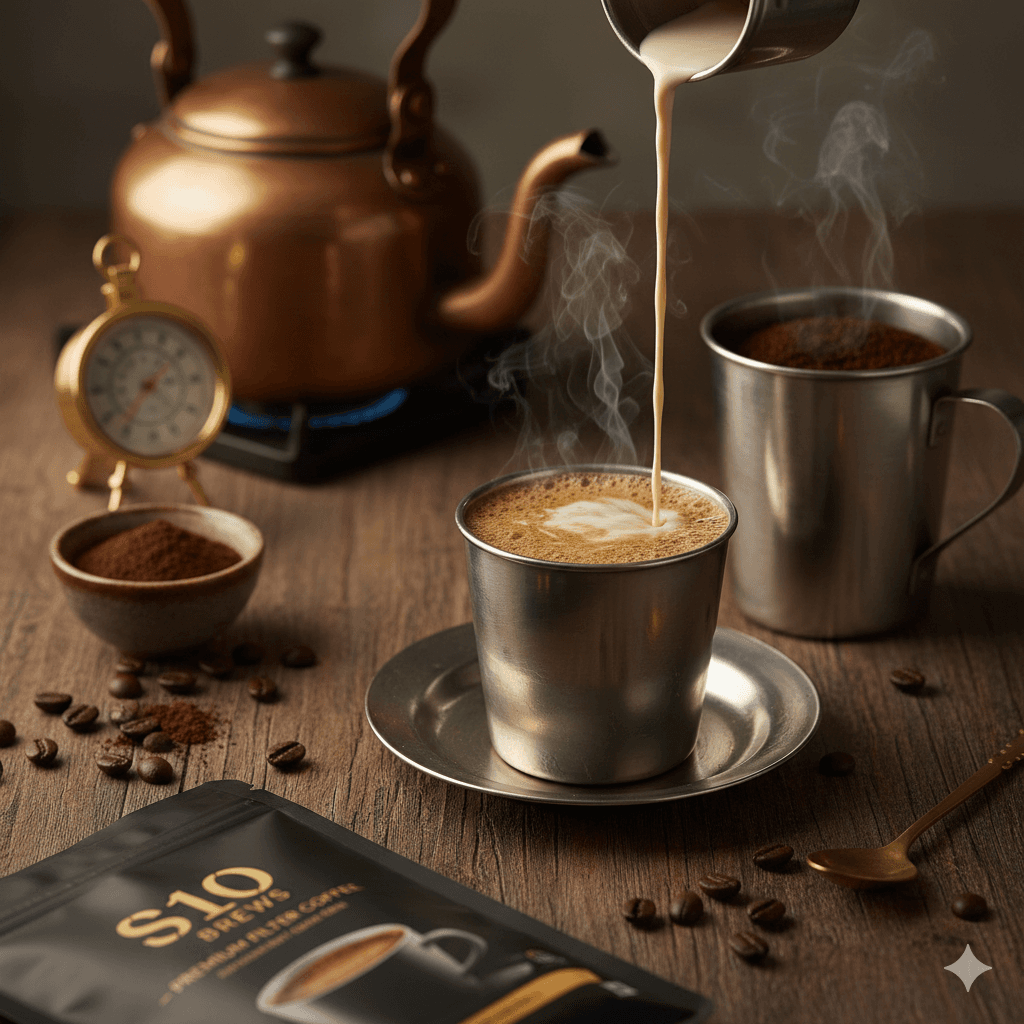
The Goldilocks Zone: Mastering Water Temperature for the Perfect Filter Coffee
You have the stainless steel dabara set ready. You have acquired a bag of premium filter coffee powder that smells like a dream. You have the vessel, the patience, and the craving. But then, you reach for the stove and a question halts your progress: Is the water too hot? Is it not hot enough?
Most coffee lovers treat water as a secondary ingredient—a mere vehicle for caffeine. In reality, water makes up nearly 98% of your cup. If your coffee tastes unpleasantly bitter, sour, or flat, it is likely not a problem with the beans, but a problem with the heat. Brewing the perfect cup of South Indian filter coffee is a delicate dance between chemistry and tradition, and the temperature of your water is the lead partner.
At S10 Brews, we believe that understanding the science of extraction is what separates a standard morning routine from a truly artisanal experience. Let’s dive into why those degrees matter and how you can achieve the perfect "Degree Coffee" at home.
What Is the Best Water Temperature for Filter Coffee?
The ideal water temperature for brewing filter coffee is between 195°F and 205°F (90°C to 96°C). This range is considered the "Goldilocks Zone" because it is hot enough to extract the desirable oils, acids, and sugars from the coffee powder without scorching the grounds and releasing astringent, burnt flavors.
Why Temperature is the Secret Ingredient in Your Decoction
When you pour water over fresh coffee powder, you are initiating a chemical extraction. Water acts as a solvent, dissolving the soluble solids hidden within the grounds.
If the water is too cold (below 190°F), it lacks the energy to pull out the complex sugars and aromatic oils. This results in "under-extraction," leaving you with a thin, sour, and disappointing brew. Conversely, if you use boiling water (212°F) directly on the grounds, you risk "over-extraction." High heat breaks down the organic compounds too quickly, releasing bitter tannins and woody flavors that mask the natural profile of a high-quality blend.
For those using a traditional South Indian metal filter, temperature control is even more critical. Because the water sits in contact with the powder for a longer duration compared to a quick pour-over, the heat must be precise to ensure the resulting decoction is thick, syrupy, and fragrant.
The Science of the Sizzle: What Happens at Different Temperatures?
To understand how to buy coffee powder online and brew it like a pro, you need to understand the three stages of the heat scale:
1. The Sour Zone (Below 190°F / 88°C)
At these temperatures, the water is too sluggish. It manages to extract the acids first (which dissolve quickly), but it fails to reach the sweet spot. The result is a cup that tastes salty or sharp. If you find your South Indian filter coffee powder isn't yielding that deep, resonant flavor, check your kettle.
2. The Sweet Spot (195°F – 205°F / 90°C – 96°C)
This is where the magic happens. The heat is sufficient to dissolve the lipids and caramelized sugars. This produces a balanced cup with a heavy body and a lingering sweetness. When using an authentic degree coffee powder, this temperature range ensures the chicory and coffee blend harmoniously rather than competing for dominance.
3. The Bitter End (Above 205°F / 96°C)
Boiling water is the enemy of premium filter coffee. It "shocks" the grounds. You might think "hotter is better" for a strong decoction, but you are actually just extracting bitterness. If you see large, aggressive bubbles in your kettle, let it sit for two minutes before pouring.
How to Measure Temperature Without a Thermometer
Not everyone has a digital culinary thermometer in their kitchen, and that shouldn't stop you from enjoying handcrafted coffee powder at its best. Here are three professional tricks to hitting the right temperature:
- The Wait Method: Bring your water to a rolling boil. Take it off the heat and let it sit uncovered for about 60 to 90 seconds. In most Indian kitchens, this delay drops the temperature to approximately 198°F—perfect for brewing.
- The Bubble Watch: Watch the bubbles. Small, pin-head-sized bubbles (often called "fish eyes" in traditional tea brewing) indicate the water is around 190°F. Once the bubbles become large and violent, you’ve hit the boiling point and need to cool it down.
- The Transfer Trick: Pouring boiling water from one vessel to another (like a ceramic jug) instantly drops the temperature by about 5-8 degrees.
Choosing the Right Roast: Does It Change the Temperature?
The roast profile of your coffee powder online purchase should dictate your temperature setting.
- Light Roasts: These beans are denser and "tougher" to extract. They benefit from the higher end of the scale (203°F - 205°F) to coax out their floral and fruity notes.
- Medium-Dark Roasts: Most traditional South Indian coffee powder falls into this category. They are more soluble and porous. Aim for 195°F to 200°F to avoid bringing out too much "charred" flavor.
- Small Batch & Artisanal Blends: When you invest in estate grown coffee powder from S10 Brews, you are dealing with delicate flavor nuances. We recommend staying strictly at 198°F to preserve the integrity of the beans.
The Role of Water Quality
While temperature is king, the "hardness" of your water acts as the king’s advisor. Distilled water is too "empty" and results in flat coffee. Highly hard water (filled with minerals) can make the coffee taste metallic or chalky. For the best South Indian coffee powder for filter coffee, use filtered tap water or bottled spring water. The minerals in filtered water act as "hooks" that help pull the flavors out of the powder.
Comparison: Traditional vs. Modern Brewing Temperatures
| Brewing Method | Ideal Temperature | Resulting Profile |
| South Indian Filter | 195°F - 202°F | Thick, syrupy decoction with chocolatey undertones. |
| French Press | 200°F | Full-bodied and textured. |
| Pour Over | 198°F - 205°F | Clean, bright, and highlights acidity. |
| Espresso | 190°F - 196°F | Intense, concentrated, and creamy. |
What Most Brewers Ignore
Most guides focus solely on the water you pour over the grounds. However, there is a missing link: The Vessel Temperature.
If you pour 200°F water into a cold stainless steel filter, the metal will immediately suck the heat out of the water, dropping the brewing temperature to a sub-optimal 180°F. To fix this, always "pre-heat" your filter. Pour some hot water through the empty filter and into your collection jar before adding your pure coffee powder. This ensures the environment remains stable throughout the slow dripping process.
Why S10 Brews is the Professional Choice
When you buy coffee powder online, you are looking for consistency. At S10 Brews, our process is built on the pillars of precision and passion. Our handcrafted coffee powder is roasted in small batches to ensure that every grain reacts predictably to heat.
We source from high-altitude estates where the beans grow slowly, developing a density that stands up beautifully to the traditional brewing process. Whether you prefer a bold, chicory-infused traditional filter coffee powder or a pure, artisanal coffee powder, our blends are designed to perform exceptionally within the 195°F – 205°F range. We don’t just sell coffee; we provide the foundation for your daily ritual.
FAQ: Everything You Need to Know About Coffee Temperature
1. Is boiling water bad for filter coffee?
Yes. Boiling water at 212°F (100°C) can scorch the delicate oils in fresh coffee powder, leading to a bitter and "burnt" taste. It is best to let the water cool for a minute after boiling.
2. What is the best South Indian coffee powder for a traditional filter?
The best powder is usually a medium-dark roast with a specific grind size—neither too fine nor too coarse. S10 Brews offers a premium filter coffee powder that is specifically calibrated for the slow-drip method.
3. Does the temperature of the milk matter in South Indian filter coffee?
Absolutely. For an authentic degree coffee experience, the milk should be frothy and piping hot, but never boiled to the point of forming a "skin." High-fat, frothed milk at around 160°F (70°C) complements the strong decoction perfectly.
4. Why does my coffee taste sour even if I use hot water?
Sourness is usually a sign of under-extraction. This happens if your water temperature is too low, your grind is too coarse, or you haven't used enough coffee powder. Ensure you are using a premium coffee powder with the correct water-to-coffee ratio.
5. Can I use a microwave to heat water for brewing?
While possible, it is not recommended. Microwaves heat water unevenly and can lead to "superheating." A stovetop kettle or an electric gooseneck kettle provides much better control for artisanal coffee powder.
6. Where can I buy authentic degree coffee powder online?
You can find authentic, estate-grown, and handcrafted blends at the S10 Brews online store. We specialize in providing fresh coffee powder that brings the taste of South India to your doorstep.
Conclusion: The Final Pour
Brewing the perfect cup of coffee is both a science and a soulful art. By simply paying attention to your water temperature, you elevate your morning ritual from a caffeine fix to a sensory experience. You honor the farmers who grew the beans and the roasters who perfected the grind.
The next time you prepare your filter, remember: don’t rush the boil. Let the water breathe, pre-heat your vessel, and use the best South Indian coffee powder available. The result will be a decoction that is rich, aromatic, and distinctly superior.
Ready to upgrade your brew? Explore our collection of premium filter coffee powder at S10 Brews and discover the difference that small-batch, handcrafted quality makes. Your perfect cup is just a few degrees away.