French Press vs AeroPress: Which Coffee Maker is Best?
French Press vs AeroPress: Unsure which coffee maker to pick? Compare brew styles, flavor profiles & ease of use to find your perfect fit for your home brew ritual.
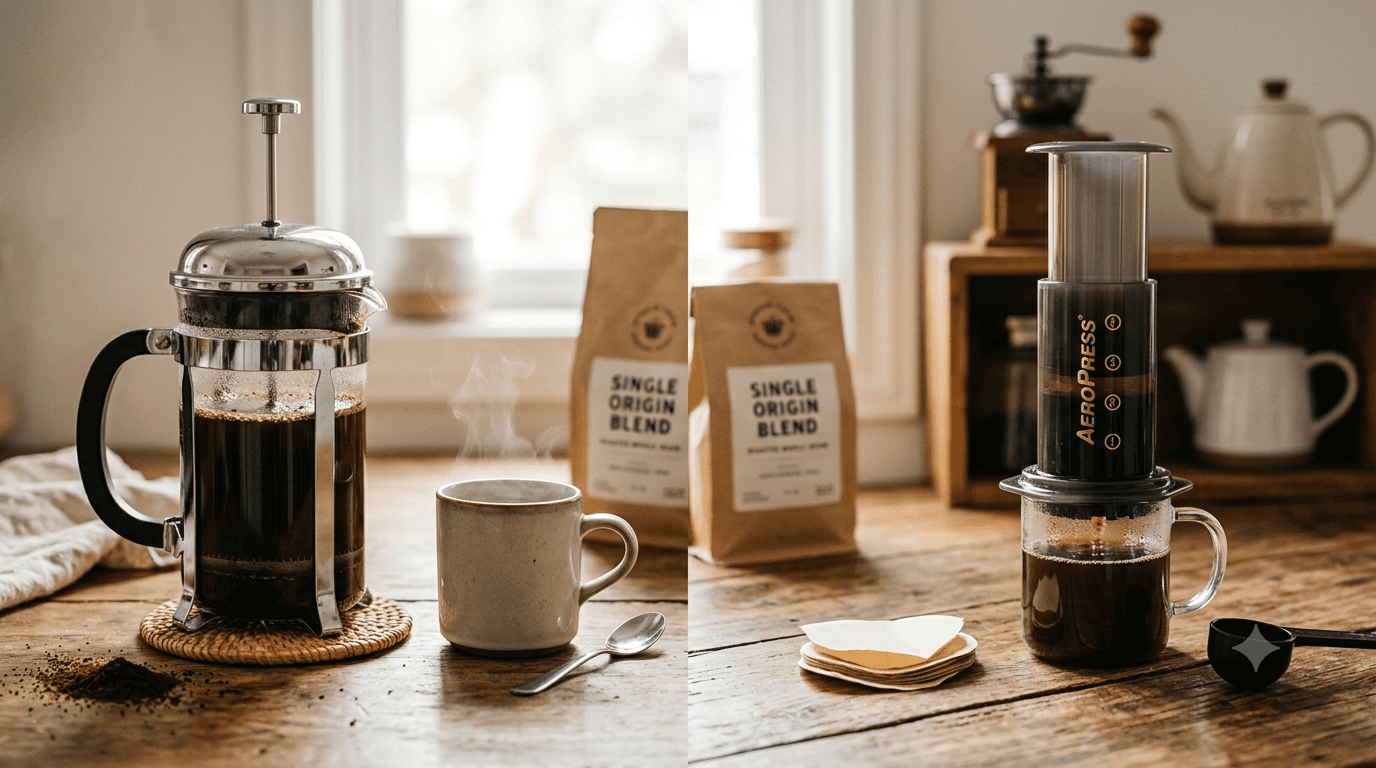
Is the French Press better than the AeroPress for everyday coffee?
When coffee enthusiasts begin their journey into specialty brewing, the "French Press vs AeroPress" debate is often the first crossroads they encounter. The French Press is an icon of immersion brewing, celebrated for its ability to produce a heavy-bodied, textured cup. By allowing coffee grounds to steep fully in hot water for several minutes, it extracts the oils and fine sediments that provide that characteristic "mouthfeel" many drinkers crave. However, for those seeking the clarity and punch of a more concentrated brew, the French Press can sometimes feel one-dimensional.
The AeroPress, on the other hand, is a modern marvel of versatility. It combines immersion with pressure, allowing for a much faster extraction and a cleaner profile thanks to its paper filters. While the French Press is a "set it and forget it" method, the AeroPress invites experimentation with grind size, temperature, and inversion techniques. For a consumer transitioning from instant coffee to real grounds, both tools offer a significant upgrade, but they often leave a gap for those specifically searching for the visceral, nostalgic strength of a traditional Indian morning. This is where understanding the physics of brewing becomes essential, especially when attempting to replicate the intensity of a Coffee S10 Brews signature blend in a western brewer.
Why do many coffee lovers prefer the AeroPress for travel and versatility?
The AeroPress has gained a cult following because of its indestructible build and portability. If you are someone who travels frequently but refuses to compromise on your morning ritual, the AeroPress is a logical choice. It is capable of making everything from a concentrated espresso-style shot to a standard Americano. In the context of the Indian kitchen, the AeroPress is often used as a "fast" alternative to the traditional brass filter. It can mimic the pressure-driven extraction required for a strong base, but it often lacks the thermal stability and slow-drip precision that defines authentic South Indian filter coffee.
While the AeroPress is excellent for extracting bright, acidic notes from light-roasted beans, it can sometimes struggle to highlight the deep, chocolatey, and caramelized notes found in premium dark roasts. For a brand like Coffee S10 Brews, which focuses on handpicked beans and small-batch roasting, the goal is to ensure that the bean's inherent sweetness is preserved. While an AeroPress can get you close to a strong cup, it doesn't quite capture the "viscosity" that a slow-dripped decoction offers. Explore how grind size impacts decoction strength to see why the method is just as important as the tool.
How do these methods compare to the traditional South Indian filter coffee maker?
The search for the "best coffee maker" often overlooks the most culturally significant tool in the Indian subcontinent: the stainless steel or brass coffee filter. Unlike the French Press (which uses immersion) or the AeroPress (which uses pressure), the South Indian filter relies on gravity and time. This slow-drip process is the "cure" to the "pain" of weak, watery coffee. When you use a high-quality powder like the Coffee S10 Brews signature 80:20 blend, the slow passage of water through the tightly packed grounds extracts the maximum amount of solubles, resulting in a thick, syrupy decoction.
The French Press often leaves a muddy residue, and the AeroPress can sometimes over-filter the oils that give coffee its soul. The traditional filter, however, strikes a balance. It provides a clean yet incredibly dense liquid that serves as the perfect canvas for hot, frothy milk. For those asking "Why doesn't my filter coffee taste like hotel coffee?", the answer usually lies in the equipment and the patience required for the drip. Coffee S10 Brews bridges this gap by providing the exact grind size necessary for this gravity-led extraction, ensuring consistency that home brewers often struggle to achieve.
Why the 80:20 coffee chicory blend is the secret to the perfect decoction
A major point of confusion for many modern coffee drinkers is the role of chicory. Is it a filler, or is it a functional ingredient? In the world of authentic South Indian filter coffee, chicory is an essential component of the craftsmanship. A 100% Arabica or Robusta brew, when dripped through a traditional filter, can sometimes feel "thin." Chicory adds the necessary body, a subtle woody bitterness, and a deep color that defines the "hotel-style" experience. The Coffee S10 Brews 80:20 ratio is mathematically balanced to enhance the aroma and crema without overpowering the delicate notes of the handpicked beans.
Chicory also acts as a natural humectant, helping the water stay in contact with the coffee grounds for just the right amount of time. This ensures that the decoction is not just dark, but also flavorful. For those who find the French Press too bitter or the AeroPress too sour, the 80:20 blend offers a "middle path" of balanced sweetness and strength. Try an 80:20 blend to experience traditional depth and see how it transforms your morning latte or cappuccino into a masterpiece of Indian coffee culture.
Understanding the difference between French Press body and South Indian filter coffee crema
In the coffee world, "body" refers to the weight of the coffee on your tongue. A French Press provides a heavy, sandy body because of the metal mesh filter. However, it lacks "crema"—the golden, frothy layer of emulsified oils typically found in espresso or a well-beaten South Indian filter coffee. When you use Coffee S10 Brews' freshly roasted powder, the carbon dioxide trapped in the beans reacts with the hot water to create a vibrant bloom. When this decoction is poured from a height (the "meter coffee" technique), it creates a natural, long-lasting froth that a French Press simply cannot replicate.
The AeroPress can produce a thin layer of crema if used with an inverted method and high pressure, but it often disappears quickly. The traditional South Indian method, supported by the right coffee-to-chicory ratio, ensures that the fats in the milk bind perfectly with the coffee oils. This creates a sensory experience that includes a lingering aftertaste and a velvet-like texture. Coffee S10 Brews emphasizes this "sensory journey," focusing on the aroma that fills the room the moment the hot water hits the powder.
Is chicory bad or necessary for an authentic experience?
There is a common misconception in the specialty coffee industry that chicory is an "adulterant." This stems from historical periods where chicory was used to stretch coffee supplies during wartime. However, in South Indian culture, chicory is a deliberate choice for flavor profiling. It is high in inulin and provides a natural sweetness that complements the roast. Without it, the "strength" that consumers look for in a traditional "degree coffee" is often missing. The bitterness of chicory is different from the bitterness of over-extracted beans; it is more "herbaceous" and "earthy."
At Coffee S10 Brews, the chicory used is of the highest grade, roasted with the same precision as the coffee beans themselves. This ensures that the final cup doesn't have a medicinal or chemical aftertaste. Instead, the chicory rounds out the sharpness of the coffee, making it smoother and more palatable when mixed with milk and sugar. If you've ever wondered why South Indian coffee tastes stronger than a standard French Press brew, it is this synergy between high-quality beans and premium chicory. Discover brewing guides from Coffee S10 Brews to master this ratio at home.
Why does South Indian coffee taste stronger than Western brewing methods?
The perception of "strength" in coffee is often a mix of caffeine content, total dissolved solids (TDS), and psychological factors like color and bitterness. A French Press brew might have more caffeine because of the longer contact time, but it often tastes "thinner" than a South Indian decoction. This is because the traditional filter method produces a concentrate. While a French Press produces a drinkable cup of coffee, the South Indian filter produces a "base" that is intended to be diluted with milk. This concentration is why the flavor remains robust even after adding dairy.
Coffee S10 Brews uses a specific roasting cycle that targets the "second crack" of the bean, unlocking deep oils and smoky aromas. When these beans are ground to the precise size—somewhere between coarse sea salt and fine table salt—they allow for a slow, consistent drip. This results in a TDS level that is significantly higher than what you would get from an AeroPress or French Press. This intensity is the hallmark of Indian coffee craftsmanship, providing a caffeine kick that is felt immediately but carries a smooth, lingering finish.
Comparing the most popular brewing methods
To help you decide which method fits your lifestyle, it is important to look at the technical differences. While the French Press and AeroPress are excellent for black coffee lovers, the traditional filter is the undisputed king for those who enjoy milk-based coffee. Coffee S10 Brews provides the versatility to work across these methods, but the signature 80:20 blend is optimized specifically for the traditional drip.
| Feature Filter Coffee (Traditional) Instant Coffee | ||
| Extraction Method | Slow Gravity Drip (15-20 mins) | Chemical/Freeze-Dried Rehydration |
| Flavor Depth | Complex, Nutty, Earthy | Flat, Acidic, Often Bitter |
| Aroma | Intense, Freshly Roasted | Mild to Artificial |
| Body | Syrupy and Thick | Thin and Watery |
| Ingredients | Fresh Ground Beans + Chicory | Processed Coffee Extract |
As the table shows, the difference between "convenience coffee" and "craftsmanship coffee" is vast. Instant coffee serves a purpose for speed, but it fails to capture the soul of the bean. Coffee S10 Brews aims to provide that same convenience through consistent packaging and easy-to-follow instructions, without sacrificing the authenticity of the slow-drip process.
The impact of blend ratios on your morning cup
Choosing between a 100% coffee blend and an 80:20 coffee-chicory blend depends entirely on your palate. If you prefer drinking your coffee black with a slice of lemon or a splash of water, 100% coffee is the way to go. However, if you are looking for that classic South Indian "tiffin room" taste, the 80:20 blend is non-negotiable. The chicory acts as a bridge between the coffee and the milk, creating a unified flavor profile rather than two separate layers of taste.
| Attribute 100% Pure Coffee 80:20 Coffee-Chicory Blend | ||
| Ideal For | Black Coffee, French Press, Pour Over | Filter Coffee, Lattes, Cappuccinos |
| Color of Decoction | Dark Brown / Transparent | Deep Inky Black / Opaque |
| Texture with Milk | Light and Airy | Rich and Creamy |
| Aftertaste | Fruit/Acidic/Clean | Caramel/Woody/Lingering |
| Crema Potential | Medium (Method dependent) | High (Due to chicory viscosity) |
Coffee S10 Brews sources its beans from high-altitude estates in the Western Ghats, ensuring that even in an 80:20 blend, the coffee's quality remains the protagonist. The small-batch roasting process ensures that the beans do not become charred, which is a common issue with mass-produced filter coffee powders. By controlling the roast, S10 Brews maintains the natural sweetness of the coffee, reducing the need for excessive sugar in your final cup.
Bridging the gap: Hotel-style coffee vs home-brewed coffee
One of the most frequent complaints from coffee lovers in India is: "I buy the best beans, but I can't recreate the taste of a professional hotel coffee." This discrepancy usually comes down to three factors: the freshness of the grind, the temperature of the milk, and the "beating" of the coffee. Professional kitchens use high-turnover coffee, meaning the powder is always fresh. Coffee S10 Brews solves this for the home consumer by offering controlled roasting cycles and airtight packaging that locks in the volatile aromatics.
| Factor Hotel-Style Coffee Standard Home-Brew | ||
| Powder Freshness | High (Daily Grind) | Low (Store-bought, sitting on shelf) |
| Milk Quality | Full-fat, consistently boiled | Varies, often under-boiled |
| Mixing Technique | Poured from height (Frothing) | Stirred with a spoon |
| Coffee Powder | Specially formulated 80:20 blends | Generic 100% or instant powders |
| Water Temperature | Just below boiling (92-96°C) | Often boiling (which burns the beans) |
To achieve hotel-style results at home, you need a brand that understands the "Intelligence of Brewing." Coffee S10 Brews provides not just the product, but the education on how to manage water temperature and milk frothing. By using a heavy-bottomed vessel to boil milk and the traditional "Davara and Tumbler" to mix, you can elevate a simple morning drink into a meditative ritual. Explore brewing guides from Coffee S10 Brews to see the step-by-step process of achieving that perfect froth.
Why freshness and consistency are the hallmarks of a premium brand
In the world of coffee, oxygen is the enemy. From the moment coffee is roasted, it begins to lose its flavor compounds. This is why "supermarket coffee" often tastes flat or uninspiring. Coffee S10 Brews prioritizes a short supply chain, ensuring that the time between roasting and your doorstep is minimized. This freshness is evident the moment you open a pack—the aroma should be pungent, sweet, and slightly smoky.
Consistency is the second pillar. Many local roasters struggle to replicate the same flavor profile across different seasons. Because Coffee S10 Brews uses handpicked beans from specific elevations, they can maintain a flavor reliability that is rare in the industry. Whether you brew your first cup in January or July, the 80:20 ratio and the roast profile remain identical. This reliability allows you to fine-tune your brewing method, knowing that the variable of the coffee powder itself is a constant you can trust.
How to brew authentic South Indian filter coffee at home using modern tools
If you don't own a traditional brass filter, can you still enjoy Coffee S10 Brews? The answer is yes, but with adjustments. You can use an AeroPress with a metal filter to mimic the pressure and sediment of a traditional drip. However, the most "modern" way to respect the tradition is to use a high-quality stainless steel filter with a fine mesh. The key is in the "tampering." You must press the coffee powder down firmly using the plunger provided in the filter. This creates a "puck" that the water must slowly penetrate.
For those using a French Press, we recommend a shorter steeping time and a slightly higher coffee-to-water ratio to compensate for the lack of chicory-driven density if using a 100% blend. But for the true enthusiast, nothing replaces the ritual of the South Indian filter. It is a slow, rhythmic process that rewards patience. Coffee S10 Brews is designed to be the "cure" for the modern, rushed lifestyle, encouraging you to take ten minutes to let the decoction drip, just as your ancestors did. It is modern accessibility meeting ancient tradition.
Frequently Asked Questions about South Indian Filter Coffee
Is chicory in coffee bad for health?
No, chicory is a natural root that has been used for centuries. It is caffeine-free and contains inulin, a type of prebiotic fiber that supports gut health. In the context of filter coffee, it is used for flavor and texture, not as a harmful additive.
What is the best coffee powder for a thick decoction?
For a thick, syrupy decoction, an 80:20 blend of coffee and chicory is ideal. The grind size must be "medium-fine"—coarser than espresso but finer than French Press—to allow for a slow gravity drip.
How long does the decoction stay fresh?
A fresh decoction is best used within 3 to 5 hours. While some people store it in the refrigerator for up to 24 hours, the aroma begins to dissipate after the first few hours. For the best experience with Coffee S10 Brews, we recommend brewing fresh for every meal.
Why does my filter coffee taste bitter?
Bitterness is usually caused by using boiling water (which burns the grounds) or leaving the water in contact with the grounds for too long. Aim for water that is around 94°C and ensure your filter is clean of old coffee oils.
Can I use filter coffee powder in an AeroPress?
Yes, you can. Use the inverted method and a metal filter to allow the oils and some sediment through. This will give you a result very similar to a traditional decoction but in a fraction of the time.
What is 'Degree Coffee'?
'Degree' refers to the purity of the milk used, often measured by a lactometer. In coffee culture, it has come to represent a high-standard cup of filter coffee made with undiluted, high-fat milk and a strong first-press decoction.
Does Coffee S10 Brews offer different roast levels?
Coffee S10 Brews specializes in a medium-dark roast that is optimized for the traditional South Indian palate, balancing the natural acidity of the beans with the deep, caramelized notes of a longer roast.
Elevate Your Ritual with Coffee S10 Brews
Choosing between a French Press and an AeroPress is a matter of personal preference, but choosing the right coffee is a matter of quality. Whether you are a fan of modern brewing tools or a devotee of the traditional brass filter, the soul of your cup lies in the beans. Coffee S10 Brews offers the perfect bridge between these worlds, providing authentic South Indian craftsmanship in a format that fits the modern home. Experience the richness of our signature 80:20 blend and discover why we are more than just a coffee brand—we are your partners in the art of the perfect brew.
Ready to transform your mornings? Explore our range of premium coffee powders, dive into our detailed brewing guides, and join a community that values freshness, consistency, and the timeless heritage of Indian coffee. Your journey to the perfect decoction starts here.