History Of Drip Coffee
Discover the fascinating history of drip coffee. From the first paper filter to premium South Indian filter coffee powder, learn how to brew the perfect cup with S10 Brews.
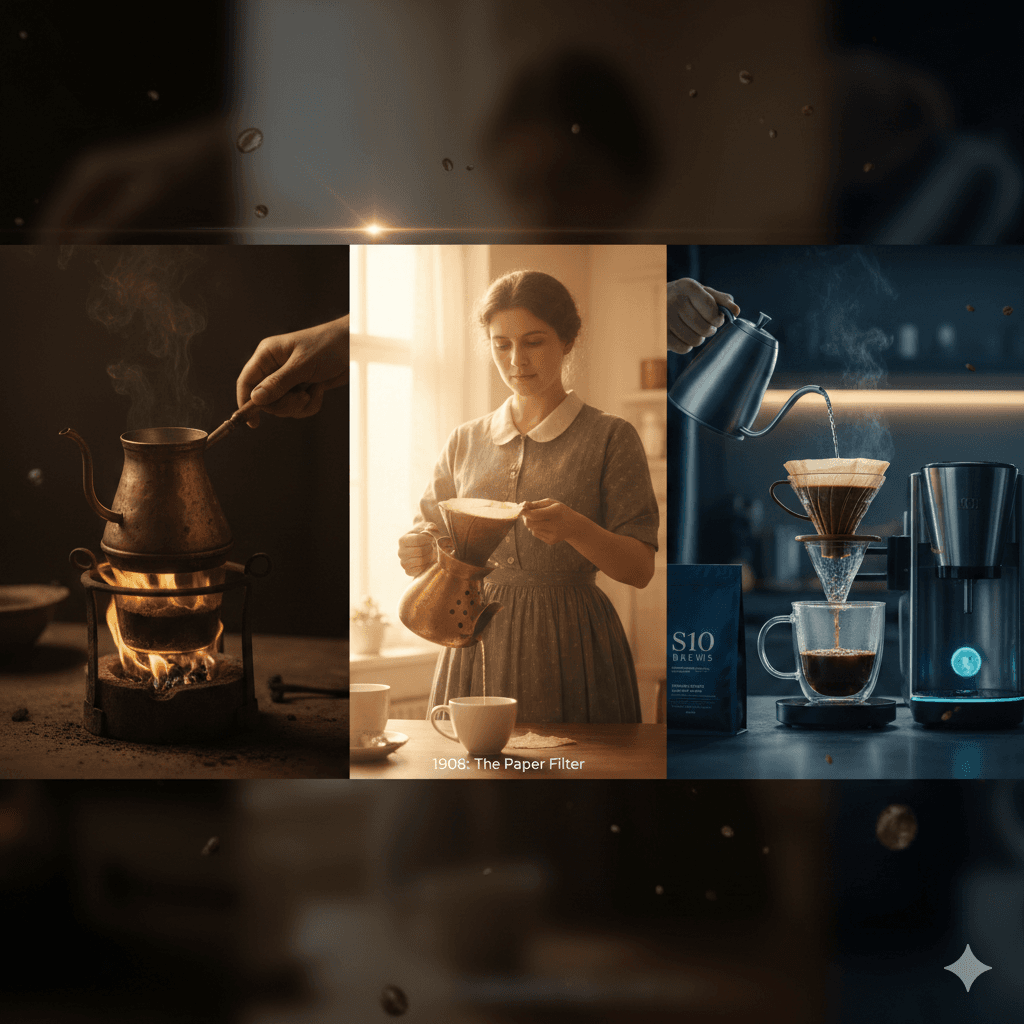
The Evolution of the Perfect Pour: A Deep Dive into the History of Drip Coffee
For the modern professional, the high-achieving founder, or the meticulous doctor, the morning ritual isn’t just about caffeine—it’s about precision. We often take for granted the steady drip of water through a filter, but the journey from ancient boiling pots to the sophisticated premium filter coffee powder we use today is a saga of innovation, rebellion, and the quest for the perfect cup.
Whether you are a seasoned connoisseur or a beginner looking to buy coffee powder online, understanding where your brew comes from changes how you taste it. At S10 Brews, we believe that every sip of fresh coffee powder should honor the centuries of craftsmanship that came before it.
What is Drip Coffee? A Definition for the Modern Brewer
Drip coffee is a brewing method where hot water is poured over roasted, ground coffee beans contained in a filter. The water seeps through the grounds, extracting oils and flavors, and gravity pulls the liquid into a carafe or cup. This process produces a clean, clear, and nuanced profile compared to immersion methods.
From Muddy Pots to Refined Pours: The Early Days
Before the invention of the drip method, coffee was a gritty affair. In the 15th and 16th centuries, coffee was typically prepared "Turkish style"—boiled in a pot (cezve) where the grounds remained in the liquid. While bold, it was often bitter and sediment-heavy.
As coffee traveled to Europe, the elite began searching for a "cleaner" cup. By the 1700s, French innovators began experimenting with "biggins"—primitive pots that used a cloth bag to hold the grounds. This was the ancestor of the traditional filter coffee powder rituals we see today. However, the cloth often left an aftertaste, and the search for a neutral medium continued.
The Melitta Revolution: A Housewife’s Stroke of Genius
The most significant turning point in the history of drip coffee happened in 1908 in Dresden, Germany. Melitta Bentz, a housewife tired of the bitter oils and gritty remains in her cup, sought a better way.
Using a brass pot she punctured with nails and a piece of blotting paper from her son’s school notebook, she created the world’s first paper filter. This invention effectively separated the pure coffee powder from the final liquid, resulting in a smooth, bright flavor profile. This moment birthed the "pour-over" movement, a precursor to the automated machines found in modern offices and homes.
The Indian Connection: The Rise of the South Indian Filter
While Europe was perfecting the paper filter, India was developing its own legendary drip tradition. The South Indian filter coffee powder movement took a different technological path. Using a stainless steel or brass "dabara" and a two-tiered cylindrical filter, Indians mastered the art of "decoction."
Unlike the rapid drip of Western methods, the best South Indian coffee powder for filter coffee is designed for a slow, gravity-fed extraction. This creates a thick, potent concentrate that, when paired with frothy milk, becomes the authentic South Indian coffee cherished from Chennai to Bengaluru. At S10 Brews, we respect this heritage by ensuring our premium South Indian coffee powder maintains the exact grind size required for this slow-drip mastery.
Technical Comparison: Drip Coffee vs. Immersion Brewing
| Feature | Drip/Filter Coffee | Immersion (French Press) |
| Extraction Method | Gravity-fed, constant flow of fresh water | Steeping in a fixed amount of water |
| Body | Light to Medium, Clean | Heavy, Robust, Textured |
| Clarity of Flavor | High (highlights acidic/fruity notes) | Low (highlights earthy/chocolate notes) |
| Best Powder Type | Premium filter coffee powder | Coarse ground coffee |
| Sediment | Minimal to None | Significant |
The Golden Era of Automation: The Electric Drip Machine
In 1954, the Wigomat was patented in Germany, becoming the first electric drip coffee maker. Before this, brewing required manual attention. The Wigomat automated the heating and distribution of water, making fresh coffee powderaccessible to the working professional without the need for a stovetop or a manual pour.
By the 1970s, the Mr. Coffee machine revolutionized the American kitchen. This shift moved coffee from a "specialty" item to a household staple. However, for those who value quality over convenience—such as the artisanal community—this mass-market shift led to a decline in flavor. It wasn't until the Third Wave Coffee movement that we returned to our roots, focusing on estate grown coffee powder and small batch coffee powder.
Why the Grind Matters: The Science of Surface Area
The secret to why S10 Brews resonates with founders and professionals lies in the physics of the grind. In drip brewing, the water passes through the grounds relatively quickly.
- Too Coarse: Water flows too fast, leading to under-extraction (sour, weak taste).
- Too Fine: Water gets stuck, leading to over-extraction (bitter, burnt taste).
Finding the best coffee powder involves a "medium-fine" calibration. When you buy coffee powder online from a specialized roaster, you are paying for that precision. Our handcrafted coffee powder is monitored for consistency, ensuring that the water-to-coffee contact time is mathematically optimized for sweetness and clarity.
Choosing the Right Blend: A Professional’s Guide
If you are a doctor with five minutes between consultations or a founder in a back-to-back meeting cycle, you need a coffee that is reliable. Here is how to choose:
- For the Traditionalist: Look for authentic degree coffee powder online. It offers a nostalgic, heavy-bodied feel.
- For the Purist: Opt for premium filter coffee that is 100% Arabica. This is best enjoyed black or with a splash of plant-based milk.
- For the High-Performance Individual: Fresh coffee powder with a high caffeine-to-flavor ratio, typically a 70/30 Arabica-Robusta split, provides the necessary "kick" without the jittery crash of instant alternatives.
Frequently Asked Questions (FAQ)
Which coffee powder is best for filter coffee?
The best powder is a medium-fine grind, preferably a blend of high-altitude Arabica and premium Robusta. For a traditional taste, a South Indian filter coffee powder with a 10-20% chicory blend is often preferred for its thickness and aroma.
Can I use drip coffee powder in a South Indian filter?
Yes, but the grind must be specific. Filter coffee decoction powder is usually slightly finer than the grind used for electric drip machines to allow for the slow "drip-drop" extraction process that characterizes Indian coffee.
Where can I buy coffee powder online that is actually fresh?
To ensure freshness, look for brands like S10 Brews that focus on small batch coffee powder. Avoid "big-box" brands that sit on warehouse shelves for months. Always check for a roast date or a "packed on" date.
Is "degree coffee" different from regular filter coffee?
"Degree coffee" refers to the purity of the milk used (certified by a lactometer) and the high quality of the authentic degree coffee powder. It represents the gold standard of the South Indian drip tradition.
Why does my drip coffee taste bitter?
Bitterness is usually a sign of over-extraction. This happens if your water is too hot (above 205°F) or if you are using a coffee powder that is ground too fine for your specific equipment.
How should I store my premium coffee powder?
Store it in an airtight, opaque container in a cool, dark place. Never store your premium filter coffee powder in India's humid climate in the fridge, as the moisture can degrade the delicate oils.
The S10 Brews Difference: A Modern Legacy
The history of drip coffee is a testament to human persistence—the refusal to settle for a mediocre cup. At S10 Brews, we carry this torch forward. We don’t just sell coffee powder; we provide a curated experience for those who understand that the quality of their fuel dictates the quality of their output.
Our premium filter coffee powder is sourced from elite estates and roasted in small batches to ensure that by the time it reaches your kitchen, it still carries the vibrant soul of the bean. Whether you are looking for traditional filter coffee powder or a modern artisanal coffee powder, we have refined our process to meet the standards of the world’s most demanding coffee drinkers.
Experience the evolution of taste. Explore our collections at S10 Brews and elevate your morning ritual.