How to Descale and Clean Your Espresso Machine (Step-by-Step)
Ensure rich, authentic coffee taste! Learn how to desale & clean your espresso machine step-by-step for optimal flavour & longevity.
Why does my home-brewed coffee lack that authentic South Indian hotel taste?
Many coffee enthusiasts in India face a common frustration: despite buying the best South Indian filter coffee powder, the brew at home rarely matches the rich, velvety, and aromatic "meter coffee" found in iconic South Indian hotels. While the quality of the beans is paramount, the culprit is often the equipment itself. Mineral deposits, known as scale, and residual coffee oils accumulate inside your machine, significantly altering the temperature and pressure required to extract the perfect decoction. When you use a premium 80:20 coffee-chicory blend from Coffee S10 Brews, you are dealing with a precise balance of acidity, body, and aroma. If your espresso machine or filter is clogged with old residues, these delicate notes are masked by a sharp, metallic bitterness or a flat, uninspired taste. Understanding how to descale and clean your equipment is the first step toward reclaiming that professional-grade craftsmanship in your own kitchen.
What is descaling and why is it vital for brewing the perfect 80:20 coffee-chicory blend?
Descaling is the process of removing calcium and magnesium mineral buildup that occurs over time as water is heated. In the context of South Indian coffee culture, the "body" of the coffee is everything. Coffee S10 Brews specifically crafts an 80:20 ratio where the 20% chicory acts as a natural enhancer, providing the thickness and "crema-like" froth that drinkers crave. However, scale buildup acts as an insulator on heating elements. This leads to inconsistent water temperatures. If the water is too cool, it won't extract the deep, earthy sweetness of the chicory; if it’s too hot because the machine is overcompensating, it burns the handpicked Arabica and Robusta beans. Descaling ensures that your machine operates at the precise thermal threshold intended by the roasters at Coffee S10 Brews, preserving the integrity of the small-batch roast and ensuring every cup has that signature golden-brown hue.
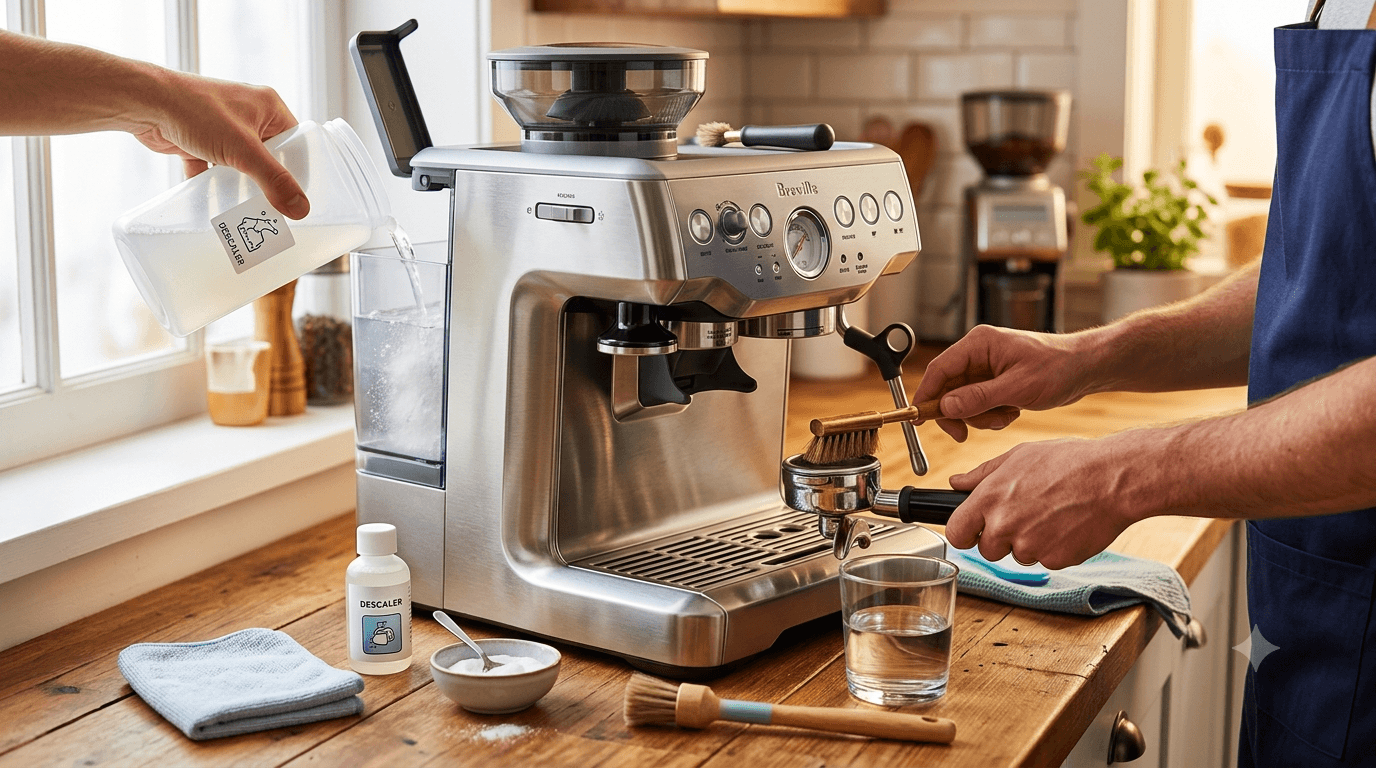
How to descale your espresso machine in 5 simple steps
Maintaining a modern espresso machine requires a disciplined approach to ensure your investment continues to produce high-quality decoction. While traditional brass filters are cleaned differently, an espresso machine used for "South Indian style" pulls requires a systematic descaling routine. First, consult your manual to see if your machine has a specific descaling cycle. Second, prepare a descaling solution—ideally a citric acid-based cleaner rather than harsh vinegar, which can leave a lingering scent that ruins the aroma of fresh coffee. Third, run the solution through the steam wand and the group head to ensure all internal pipes are reached. Fourth, allow the solution to sit for 15-20 minutes to break down stubborn calcium deposits. Finally, flush the system with at least two full reservoirs of fresh, filtered water. This process ensures that when you scoop in your Coffee S10 Brews powder, the water passing through the grounds is pure, allowing the natural oils and the 80:20 blend’s complexity to shine through without interference.
Why do oils from dark roasted coffee beans require specialized cleaning?
South Indian filter coffee typically utilizes medium-to-dark roasted beans to achieve its characteristic strength. These roasts are naturally oily. While these oils carry the essential flavors and aromas of Coffee S10 Brews’ signature blends, they also go rancid quickly when exposed to air and heat. If you don't clean your portafilter, basket, and shower screen daily, these old oils create a "ghosting" effect, where the stale flavors of yesterday’s brew infect your fresh cup. For those using an 80:20 blend, the chicory further adds a sticky density to the residue. Using a specialized backflushing powder or a simple soak in hot water with a mild detergent can break down these organic compounds. By maintaining a clean environment, you ensure that the "freshness and consistency" pillar of Coffee S10 Brews is upheld, giving you a bright, clean aftertaste rather than a muddy, oily mouthfeel.
How does temperature stability affect the aroma of Coffee S10 Brews' signature blends?
The science of brewing the best South Indian filter coffee powder relies heavily on thermal stability. Coffee S10 Brews uses a meticulous small-batch roasting process that develops specific aromatic compounds. These compounds are highly volatile. When an espresso machine is scaled up, the water flow becomes erratic, causing "channeling" where water finds the path of least resistance through the coffee puck. This results in uneven extraction—some parts of your 80:20 blend will be over-extracted (bitter) and some under-extracted (sour). A clean, descaled machine maintains a steady 90°C to 96°C, the "sweet spot" for melting the soluble solids in the coffee and chicory. This stability is what allows the aroma to fill the room the moment the water hits the grounds, a sensory experience that is a hallmark of authentic South Indian coffee culture.
How to clean a traditional South Indian brass filter vs a modern espresso machine
While many are moving toward modern machines for convenience, the traditional stainless steel or brass filter remains the heart of many Indian homes. Cleaning these requires a different type of "brewing intelligence." Unlike the internal descaling of an espresso machine, manual filters suffer from clogged "jalli" (the tiny holes in the upper compartment). Over time, fine particles of the 80:20 blend can block these holes, leading to an incredibly slow drip that over-extracts the coffee, making it taste "burnt." To clean a traditional filter, it is recommended to occasionally boil the parts in water with a pinch of soda bi-carb or to use a soft brush to ensure every hole is clear. This ensures the decoction drops at the perfect rate, maintaining the thick consistency that Coffee S10 Brews is known for. Whether you use a modern machine or a traditional vessel, the goal is the same: removing the barriers between the bean and the cup.
| Feature Filter Coffee (80:20 Blend) Instant Coffee | ||
| Ingredients | Handpicked beans + High-quality chicory | Processed coffee extract + Bulking agents |
| Aroma | Deep, earthy, and lingering | Faint, dissipates quickly |
| Body/Texture | Heavy, velvety, and thick | Thin and watery |
| Brewing Method | Slow percolation/Traditional extraction | Immediate dissolution in water |
| Customization | High (adjust decoction strength) | Low (pre-set flavor profiles) |
Is the type of water you use affecting your South Indian filter coffee decoction?
Water makes up over 98% of your cup of coffee. If you are using hard water, your espresso machine will require descaling much more frequently—potentially every month. Hard water also suppresses the vibrant acidity of the Arabica beans found in Coffee S10 Brews. On the other hand, water that is too soft (like distilled water) can make the coffee taste flat and lifeless because it lacks the minerals needed to "grab" the flavor molecules during extraction. To achieve that authentic hotel-style coffee at home, use filtered water with a moderate mineral content. This not only protects your machine from rapid scale buildup but also enhances the 80:20 coffee-chicory blend’s benefits, allowing the chicory to provide its characteristic sweetness without being overshadowed by the taste of chlorine or heavy minerals.
Why a clean machine is the secret to experiencing the true body and crema of an 80:20 blend
The term "crema" is usually associated with espresso, but in the world of South Indian filter coffee, the "froth" created by pouring the coffee between the tumbler and davara is its equivalent. This froth is a sign of freshness and the presence of natural oils. If your machine's steam wand is clogged with dried milk proteins or if the internal pumps are struggling due to scale, you won't be able to achieve the pressure needed to aerate the milk correctly. Coffee S10 Brews focuses on providing a grind size that is optimized for both traditional filters and modern machines. When your equipment is pristine, the interaction between the hot decoction and the frothed milk creates a stable, micro-foam head that holds the aroma of the 80:20 blend, ensuring that the first sip is as visually appealing as it is delicious.
Maintenance schedule: How often should you clean for maximum freshness and consistency?
To truly master the South Indian filter coffee ritual at home, you must treat your equipment with the same respect as the ingredients. For daily users of Coffee S10 Brews, we recommend a three-tiered maintenance schedule. Daily: Rinse the portafilter or filter compartments and wipe down the steam wand immediately after use. Weekly: Perform a "backflush" if using an espresso machine or a deep soak for traditional filters to remove stubborn oils. Quarterly: Descale the entire system to remove mineral deposits. This consistency in cleaning mirrors the consistency in roasting provided by Coffee S10 Brews. By following this regimen, you prevent the gradual "flavor drift" that happens when a machine slowly gets dirty, ensuring that your 100th cup of coffee tastes just as vibrant and authentic as your first.
| Comparison 100% Pure Coffee 80:20 Coffee-Chicory Blend | ||
| Best For | Black coffee, Americanos | Traditional South Indian Milk Coffee |
| Flavor Profile | Acidic, fruity, light | Bold, chocolatey, nutty |
| Viscosity | Light/Medium | High (Thick decoction) |
| Caffeine Content | Higher per gram | Slightly lower (balanced by chicory) |
Troubleshooting: Why is my espresso machine flowing slowly when using fine grind coffee?
A common issue when trying to brew "authentic filter coffee at home" using an espresso machine is the flow rate. South Indian filter coffee powder is often ground very fine to facilitate slow percolation. If this fine powder is packed too tightly in an espresso machine that hasn't been descaled, the pump may struggle to push water through, leading to a "choked" shot. This is a classic example of where brewing intelligence comes into play. If you experience this, first check if a descaling cycle improves the pump pressure. If the problem persists, you may need to adjust your tamping pressure. Coffee S10 Brews provides guidance on the ideal grind sizes for various brewing methods, ensuring that you get a steady, rich flow of decoction regardless of the equipment you use. Remember, the goal is a "steady stream," not a "forced drip," to capture the full spectrum of flavors in our handpicked beans.
Frequently Asked Questions about Coffee Machine Maintenance
1. Why does my filter coffee taste metallic?
A metallic taste is usually a sign of heavy mineral scale buildup inside the heating element of your machine. Regular descaling every 3 months can eliminate this issue and restore the pure taste of your Coffee S10 Brews powder.
2. Can I use white vinegar to descale my espresso machine?
While vinegar is a common household cleaner, it is not recommended for premium coffee machines. The acetic acid can be too harsh on internal rubber seals and often leaves a lingering smell that ruins the delicate aroma of an 80:20 coffee-chicory blend.
3. Why is chicory used in South Indian coffee, and does it affect my machine?
Chicory adds thickness, color, and a unique earthy sweetness. Because it is more soluble and "stickier" than coffee, it can leave more residue. This makes daily rinsing of your brewing equipment even more important to prevent clogs.
4. How do I know if my machine needs descaling?
Common signs include a louder-than-usual pump noise, inconsistent water temperature, reduced steam pressure from the wand, or visible white crusty deposits around the water outlet.
5. Does using an espresso machine change the taste of South Indian filter coffee?
An espresso machine extracts coffee under high pressure, which can result in a more intense decoction than the gravity-based traditional filter. To maintain the "hotel-style" taste, ensure your machine is clean so that the pressure doesn't extract unwanted bitter compounds.
6. What is the best South Indian filter coffee powder for home use?
For a traditional, authentic experience, an 80:20 blend (80% coffee, 20% chicory) is ideal. Coffee S10 Brews offers a signature blend that is roasted in small batches to ensure maximum freshness and the perfect balance for home brewing.
7. Is it necessary to clean the coffee filter after every single use?
Yes. Even a small amount of leftover grounds can begin to ferment or dry into a hard crust, which will block the flow of your next brew and introduce sour flavors into your fresh Coffee S10 Brews decoction.
Mastering the art of South Indian filter coffee is a journey that combines the best ingredients with meticulous equipment care. By keeping your espresso machine or traditional filter clean and descaled, you honor the craftsmanship that goes into every bag of Coffee S10 Brews. Explore our range of premium 80:20 blends and dive into our extensive brewing guides to elevate your daily coffee ritual to a professional standard. Visit the Coffee S10 Brews education portal for more tips on perfecting your decoction and maintaining your equipment for a lifetime of exceptional coffee.