How to Make Espresso-Style Coffee with an AeroPress
Learn to craft intense, espresso-style coffee with your AeroPress! Coffee S10 Brews shares expert tips for café-like brews in your modern Indian home.
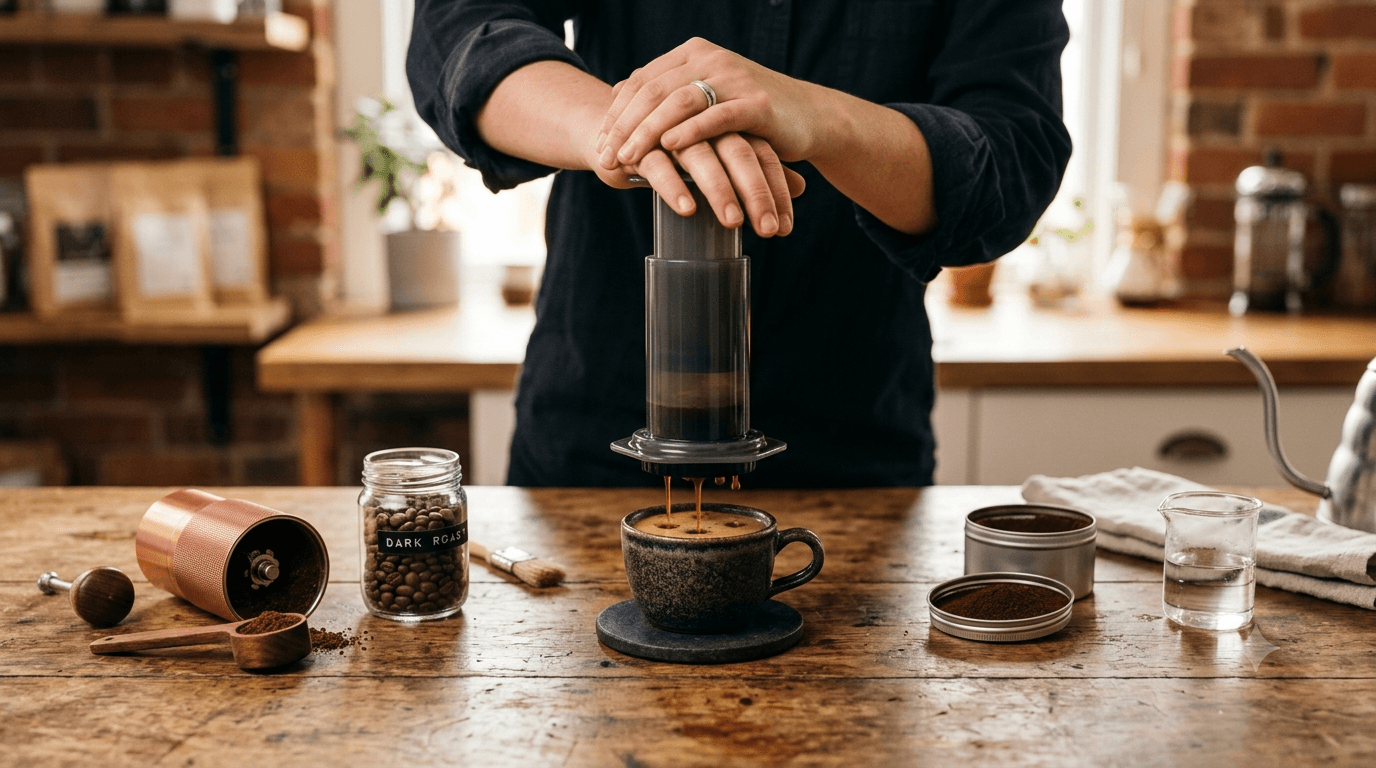
Why is the AeroPress the modern answer to the traditional South Indian brass filter?
For decades, the South Indian kitchen has been incomplete without the rhythmic "drip-drip" of the stainless steel or brass coffee filter. However, the traditional method requires patience—often taking 20 to 30 minutes to yield a thick decoction. Enter the AeroPress: a modern brewing marvel that utilizes air pressure to mimic the extraction process of the traditional filter but in a fraction of the time. While purists might initially hesitate, the AeroPress is uniquely suited for brewing "espresso-style" concentrates that serve as the perfect base for South Indian milk coffee. By leveraging the consistent grind size and premium roasting of Coffee S10 Brews, the AeroPress allows you to achieve that elusive hotel-style viscosity and depth without the long wait. It bridges the gap between old-world craftsmanship and the fast-paced lifestyle of the modern coffee lover.
What makes the best South Indian filter coffee powder for an AeroPress espresso?
The secret to a soul-satisfying cup of filter coffee isn’t just the gadget; it’s the chemistry of the powder. To achieve an authentic taste in an AeroPress, you cannot use standard espresso beans or light-roast specialty coffees. You need a blend specifically designed for milk-based consumption. Coffee S10 Brews specializes in this craft, selecting high-altitude Arabica and Robusta beans that are handpicked and roasted in small batches to ensure a uniform flavor profile. The ideal powder must have a medium-to-coarse grind—slightly finer than what you would use for a traditional drip filter but coarser than a standard espresso grind—to allow the AeroPress to build sufficient pressure without clogging. This precision ensures that every drop of decoction carries the full-bodied aroma and rich oils essential for a classic "Kaapi" experience.
Why is the 80:20 coffee–chicory blend essential for authentic hotel-style taste?
One of the most frequent questions from home brewers is, "Why doesn’t my coffee taste like the one from the famous South Indian hotels?" The answer almost always lies in the chicory ratio. A 100% pure coffee brew often lacks the "thickness" or "body" required to stand up against hot, frothy milk. Coffee S10 Brews utilizes a signature 80:20 coffee-to-chicory blend, which is the gold standard for South Indian filter coffee. Chicory serves a dual purpose: it acts as a natural thickener, providing a syrupy mouthfeel, and it enhances the extraction of the coffee's darker, chocolatey notes. When brewed through an AeroPress, this 80:20 ratio creates a dense decoction that mimics a commercial espresso shot but with the distinct woody and earthy undertones that define Indian coffee culture.
How to brew authentic filter coffee at home using the AeroPress inverted method?
To get the strongest decoction possible, the "Inverted Method" is the preferred technique for AeroPress users. This method allows for a longer immersion time, ensuring that the Coffee S10 Brews powder fully saturates before the pressure is applied. Start by placing the plunger into the chamber and flipping it upside down. Add two heaped tablespoons (approx. 18-20g) of the 80:20 blend. Pour in about 60-80ml of hot water (ideally around 92°C). Stir vigorously for 30 seconds to ensure no dry pockets remain. This agitation is crucial for releasing the oils. Let it steep for another 90 seconds. Finally, attach the filter cap with a rinsed paper filter, flip it onto a sturdy mug, and press down slowly but firmly. What you receive is a concentrated, "espresso-style" decoction that is virtually identical to a traditional first-press extract.
How does grind size impact the strength of your South Indian coffee decoction?
Grind size is the most overlooked variable in the home brewing ritual. If the grind is too fine (like flour), the AeroPress will become impossible to push, leading to over-extraction and a harsh, burnt taste. If the grind is too coarse (like sea salt), the water will pass through too quickly, resulting in a thin, sour liquid that tastes nothing like authentic filter coffee. Coffee S10 Brews maintains rigorous standards for its grind consistency, ensuring that the powder is optimized for both traditional filters and modern pressure-based brewers. For the AeroPress, a "medium-fine" grind ensures that the water interacts with enough surface area of the coffee and chicory to extract the maximum TDS (Total Dissolved Solids), giving you that rich, dark liquor that retains its character even after the addition of milk and sugar.
Why does South Indian coffee taste stronger than standard Western espresso?
Strength in coffee is often confused with caffeine content, but in the context of South Indian coffee, "strength" refers to the intensity of flavor and body. While a Western espresso relies on 9 bars of machine pressure, South Indian filter coffee relies on time and the natural binding properties of chicory. Because Coffee S10 Brews uses premium Robusta beans alongside Arabica, the caffeine kick is substantial, but the flavor is anchored by deep, caramelized notes rather than the bright acidity found in Western roasts. When you use an AeroPress to brew this blend, the manual pressure creates a micro-emulsion of oils and fine particles. This results in a cup that feels "heavier" on the palate, allowing the coffee flavor to cut through the fats of the milk, a sensation that is often lost when using lighter, international blends.
Comparison of Brewing Methods and Blends
Understanding the differences between various coffee formats helps in choosing the right product for your morning ritual. Below is a comparison of how Coffee S10 Brews stacks up against other common options.
| Feature Coffee S10 Brews (80:20 Filter Coffee) Instant Coffee Powder 100% Pure Arabica Espresso | |||
| Body & Mouthfeel | Heavy, syrupy, and coating | Thin and watery | Moderate to high, but acidic |
| Aroma | Rich, earthy, and nutty | Faint and processed | Floral, fruity, or bright |
| Milk Compatibility | Excellent; holds flavor in milk | Poor; gets diluted easily | Moderate; often better as black coffee |
| Brewing Time | 2 mins (AeroPress) / 20 mins (Traditional) | 30 seconds | 30 seconds (requires expensive machine) |
Furthermore, it is essential to understand the distinction between the home-brewed experience and what you might find in a high-end commercial establishment.
| Criteria Hotel-Style "Degree" Coffee Standard Home-Brewed Coffee Coffee S10 Brews (AeroPress Method) | |||
| Decoction Strength | Very High (First Press only) | Low to Medium (Mixed presses) | High (Controlled extraction) |
| Milk Quality | Full-fat, undiluted milk | Standard packaged milk | Optimized with manual frothing |
| Consistency | Varies by batch | Highly variable | Consistent due to small-batch roasting |
The secret to the perfect froth: Achieving the iconic Kumbakonam degree coffee texture
Once you have mastered the AeroPress decoction using Coffee S10 Brews, the final step is the "frothed milk" ritual. Authentic South Indian coffee must have a layer of bubbles on top—this isn't just for aesthetics; it aerates the coffee and balances the temperature. To achieve this at home without a professional steamer, use a simple hand-frother or the traditional method of pouring the coffee between two containers (the Davara and Tumbler) from a height. This "stretching" of the milk creates a creamy micro-foam. When the thick 80:20 decoction meets the frothed, hot milk, it creates a gradient of color and a velvety texture that is the hallmark of premium Kumbakonam degree coffee. Coffee S10 Brews provides the structural integrity in the brew to ensure the froth doesn't collapse immediately.
Is chicory bad or necessary for the South Indian coffee experience?
There is a common misconception in the specialty coffee world that chicory is an "adulterant" used to lower costs. While it historically became popular for economic reasons, in South Indian culture, it has evolved into a functional necessity. Pure coffee can often be too thin and acidic for the traditional palate. Chicory adds a woody, balsamic-like depth and reduces the overall acidity, making the brew smoother on the stomach. More importantly, it provides the "grip" that allows the coffee flavor to linger on the tongue after a sip. Coffee S10 Brews uses only the highest quality roasted chicory root, ensuring it complements rather than overpowers the handpicked beans. For anyone seeking the authentic "Madras Kaapi" soul, the 80:20 blend is not just an option—it is the requirement.
How to maintain the freshness and aroma of your coffee powder at home?
Coffee is a perishable product; its greatest enemies are oxygen, moisture, and light. To ensure that your Coffee S10 Brews powder retains its signature aroma from the first cup to the last, storage is key. Always transfer the powder into an airtight glass or ceramic container. Avoid keeping it in the refrigerator, as the moisture can lead to mold and flavor degradation. Our small-batch roasting philosophy ensures you receive the freshest possible product, but we recommend consuming the powder within 3-4 weeks of opening. When using the AeroPress, you will notice a "bloom" (small bubbles) when hot water hits the fresh powder—this is a sign of recent roasting and the release of carbon dioxide, guaranteeing a vibrant cup of coffee.
Frequently Asked Questions About South Indian Filter Coffee
- Why does my filter coffee taste bitter instead of strong? Bitterness usually comes from over-extraction or using boiling water. Ensure your water is around 90-92°C and that you aren't steeping the powder for more than 3 minutes in your AeroPress. Using a premium blend like Coffee S10 Brews also reduces bitterness due to our controlled roasting process.
- Can I use Coffee S10 Brews powder in a regular drip coffee maker? Yes, but the result will be thinner than a traditional decoction. To get the best results in a drip machine, use less water than usual to create a concentrated brew that can then be mixed with milk.
- What is the difference between Arabica and Robusta in a filter coffee blend? Arabica provides the delicate aroma and sweetness, while Robusta provides the caffeine, body, and the "crema-like" top. Coffee S10 Brews carefully balances both to ensure a complex yet powerful cup.
- Is the 80:20 ratio better than a 70:30 ratio? An 80:20 ratio is generally preferred by those who want a stronger coffee flavor with just enough chicory for body. A 70:30 ratio is thicker and more "mellow," often found in railway-style or very traditional street-side stalls.
- How much milk should I add to the AeroPress decoction? The ideal ratio is 1:2. One part decoction to two parts hot, frothed milk. Adjust according to your preference for strength, but always add sugar to the decoction before adding milk to help the flavors bind.
- Why use an AeroPress instead of a French Press for filter coffee? An AeroPress uses pressure to force the water through the grounds, which better mimics the "squeeze" of a traditional filter. A French Press is a pure immersion method and often results in a grittier, less concentrated liquid that doesn't pair as well with milk.
Master the Ritual with Coffee S10 Brews
Brewing the perfect cup of South Indian filter coffee is an art form that balances tradition with modern technique. Whether you are using a centuries-old brass filter or a contemporary AeroPress, the quality of your base ingredient is the most critical factor. Coffee S10 Brews is dedicated to preserving the authenticity of Indian coffee culture by providing home brewers with the same premium, small-batch roasted blends used by master brewers. Our commitment to the 80:20 ratio, handpicked beans, and consistent grinding ensures that you can recreate the magic of a South Indian café in your own kitchen.
Ready to elevate your morning ritual? Explore our range of authentic blends and detailed brewing guides to become a master of the Kaapi craft.
- Discover our Signature 80:20 Blends
- Browse our Comprehensive Brewing Education Resources
- Join the Coffee S10 Brews Community for Fresh Roasts Delivered Home