Pour Over Coffee Technique
Learn the expert pour over coffee technique using premium filter coffee powder. Discover tips for the perfect bloom, grind size, and where to buy coffee powder online.
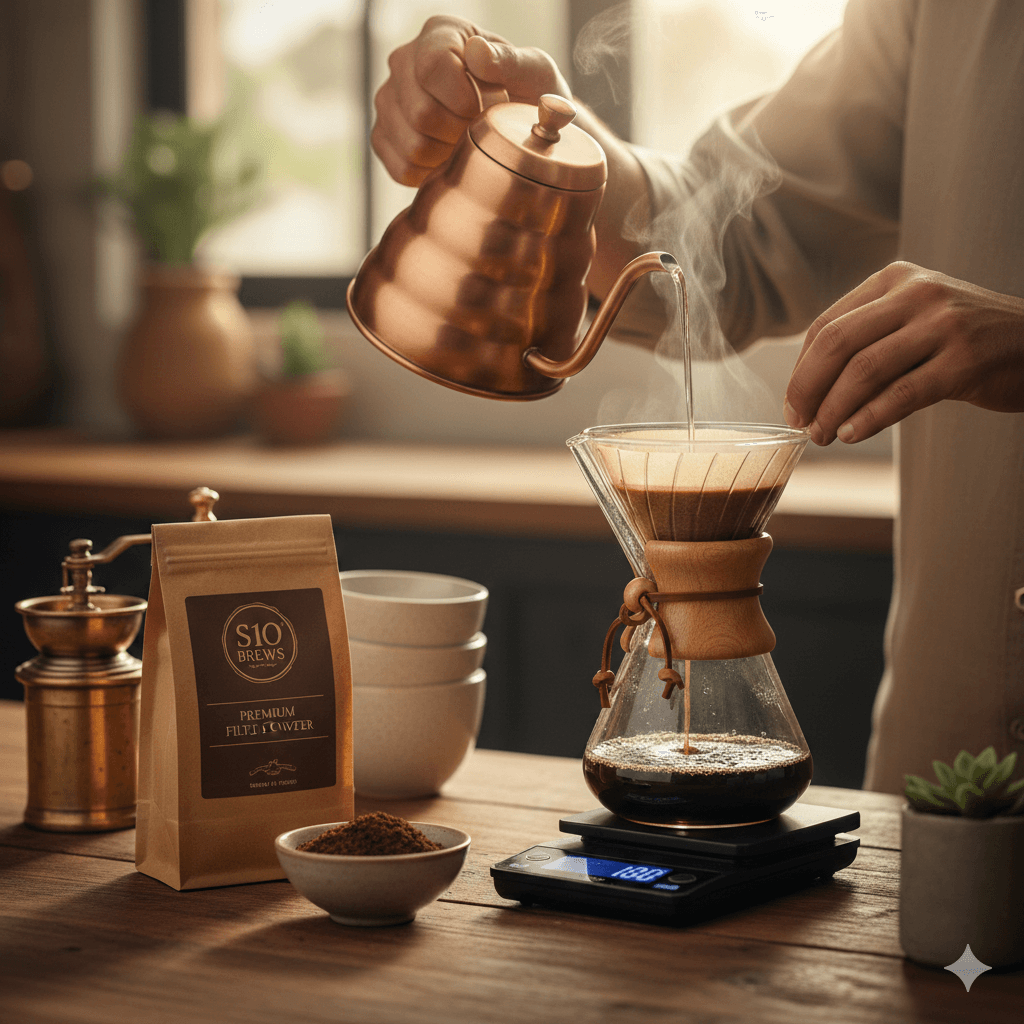
Mastering the Pour Over Coffee Technique: A Guide to the Perfect Ritual
The difference between a mediocre morning and an extraordinary one often comes down to the clarity of your cup. For the modern professional, the founder building a legacy, or the doctor seeking a moment of zen before a long shift, coffee is more than caffeine—it is a ritual.
While many reach for a quick fix, the true connoisseur knows that the pour over coffee technique offers a level of precision and flavor profile that immersion methods simply cannot match. It is the gold standard for those who appreciate the nuances of a premium coffee powder and the science behind a perfect extraction.
In this guide, we will demystify the pour over process, analyze why your current brew might be falling short, and show you how to achieve cafe-quality results at home using the finest Indian beans.
What is the Pour Over Coffee Technique?
The pour over coffee technique is a manual brewing method where hot water is poured steadily over fresh coffee powder held in a filter. This process allows the water to extract oils and soluble solids at its own pace, resulting in a clean, crisp, and flavor-forward cup that highlights the unique characteristics of the bean's origin.
Unlike pressurized methods, the pour over relies on gravity. This gentle extraction prevents the over-bitterness often found in automated machines, making it the preferred choice for those who buy coffee powder online with a focus on quality and origin.
Why Your Current Brew Doesn't Taste Like a Professional Cafe
Most home brewers struggle with consistency. If your coffee tastes sour, it is likely under-extracted; if it is harsh and bitter, it is over-extracted. Competitor brands often focus on convenience over chemistry, but at S10 Brews, we understand that the soul of the coffee lies in the grind and the water temperature.
The primary culprit is often the quality of the "fresh coffee powder" being used. Most commercial options are stale before they hit the shelf. To achieve a professional-grade pour over, you need artisanal coffee powder that has been roasted in small batches to preserve its volatile aromatic compounds.
The Essential Gear: Setting Up Your Laboratory
To master this technique, you need the right tools. While you can improvise, precision gear ensures that your "premium filter coffee" actually tastes premium.
- The Dripper: Options like the Hario V60, Chemex, or Kalita Wave offer different flow rates. The V60 is favored for its ability to highlight acidity and complex notes.
- The Filter: Paper filters remove most oils and micro-fines, producing the "clean" mouthfeel characteristic of this method.
- Gooseneck Kettle: This is non-negotiable for flow control. You cannot achieve a steady, circular pour with a standard kitchen kettle.
- Digital Scale: We measure in grams, not spoons. Consistency requires a 1:15 or 1:16 coffee-to-water ratio.
- Premium Coffee Powder: Whether you prefer a pure coffee powder or a traditional South Indian coffee powder online, the quality of the grind must be medium-coarse, resembling sea salt.
Step-by-Step: The S10 Brews Pour Over Method
1. The Prep and Rinse
Place your filter in the dripper and rinse it with hot water. This removes the "papery" taste and preheats your vessel. Discard the rinse water.
2. The Measurement
Add 20 grams of premium filter coffee powder to the filter. Gently tap the side to level the grounds. This ensures the water travels through the coffee bed evenly.
3. The Bloom (The Most Important 30 Seconds)
Pour roughly 40 grams of water (double the weight of the coffee) over the grounds. Start from the center and spiral outward. Stop and wait for 30–45 seconds. You will see bubbles forming—this is "blooming," where CO2 escapes. If your coffee doesn't bloom, it isn't fresh coffee powder.
4. The Main Pour
Continue pouring in slow, concentric circles. Avoid pouring directly onto the edges where the water might bypass the coffee (channeling). Maintain a steady water level until you reach your target weight (300g–320g for a 20g dose).
5. The Draw Down
Let the water filter through completely. The remaining grounds should be flat, indicating an even extraction. If they are slumped against the sides in a cone shape, your pouring technique needs more stability.
Decoding the Beans: From South Indian Tradition to Modern Craft
India has a rich coffee heritage, often centered around the "authentic South Indian coffee" experience. Traditionally, this involves a metal filter and a heavy chicory blend. However, the modern pour over movement has sparked a resurgence in appreciating "estate grown coffee powder" and "handcrafted coffee powder" without additives.
| Coffee Type | Best Used For | Flavor Profile |
| Pure Coffee Powder | Pour Over / AeroPress | Bright, acidic, fruity, and floral |
| Traditional Filter Coffee Powder | South Indian Metal Filter | Bold, nutty, chocolatey, and heavy |
| Small Batch Coffee Powder | Precision Brewing | Nuanced, complex, and high clarity |
If you are looking for the "best South Indian coffee powder for filter coffee," consider how the brewing method changes the flavor. A "degree coffee powder" is designed for strength, whereas an "artisanal coffee powder" from S10 Brews is designed for the delicate layers of a pour over.
What Other Roasters Won't Tell You
Most competitors—from Blue Tokai to Third Wave—focus heavily on the roast profile. While important, they often overlook the impact of water chemistry and altitude on the "premium coffee powder" experience.
The minerals in your water (magnesium and calcium) act as "tongs" that pull flavors out of the coffee. If you are using heavily chlorinated tap water, even the "best coffee powder" in the world will taste flat. For a truly superior cup, use filtered water with a neutral pH. Additionally, Indian coffees grown at higher altitudes in regions like Chikmagalur or Coorg possess a denser bean structure, requiring a slightly higher water temperature (around 94°C) to extract effectively.
Why S10 Brews is the Choice for the Discerning Palate
At S10 Brews, we don't just sell "coffee powder online." We curate an experience for those who value the "small batch coffee powder" philosophy. Our process involves:
- Hand-Selection: Only the densest, most flavorful cherries make the cut.
- Precision Roasting: We roast in small batches to ensure that every bag of "fresh coffee powder" reaches you at its peak aromatic state.
- Transparency: From the estate to your cup, we champion the "estate grown coffee powder" movement, ensuring fair practices and superior quality.
Whether you are looking for a "premium South Indian coffee powder" for a nostalgic morning or a "pure coffee powder" for a technical pour over, S10 Brews provides the consistency that high-performers demand.
Frequently Asked Questions
Which coffee powder is best for filter coffee?
The best coffee powder for filter coffee depends on your equipment. For a traditional South Indian filter, a blend with 20-30% chicory is preferred. For a pour over or drip filter, a "pure coffee powder" (100% Arabica) with a medium-coarse grind is ideal to capture delicate flavor notes.
Where can I buy coffee powder online that is actually fresh?
You should look for brands that roast to order. S10 Brews and other artisanal roasters ensure that the "fresh coffee powder" you receive was roasted within days of shipping, unlike mass-market brands that sit on shelves for months.
What is the difference between "degree coffee powder" and regular coffee?
"Degree coffee" refers to the high quality and purity of the milk and the decoction used in South Indian traditions. "Degree coffee powder" is typically a high-quality blend of Arabica and Robusta beans, often with a specific percentage of chicory to create a thick, frothy, and potent brew.
Can I use "Indian filter coffee powder" in a V60?
Technically, yes, but traditional "Indian filter coffee powder" often contains chicory and is ground very fine. This can clog a paper filter in a V60. For pour overs, it is better to use a "premium filter coffee powder" that is 100% coffee and medium-ground.
Why is my pour over coffee bitter?
Bitterness is usually a sign of over-extraction. This happens if your water is too hot, your grind is too fine, or your pouring time is too long. Try coarsening your grind or lowering your water temperature slightly.
Is "handcrafted coffee powder" worth the extra cost?
Yes. Unlike mass-produced coffee, "handcrafted coffee powder" involves meticulous sorting to remove defective beans that cause "off" flavors. This results in a cleaner, healthier, and more vibrant cup of coffee.
Elevate Your Morning Ritual
The pour over coffee technique is an investment in your daily well-being. It forces a moment of mindfulness in a chaotic world. By choosing a "premium filter coffee powder" and mastering the slow pour, you aren't just making a drink; you are honing a craft.
If you are ready to move beyond the ordinary, explore our collection of "artisanal coffee powder" at S10 Brews. We specialize in "estate grown coffee powder" that brings the best of Indian hills directly to your kitchen. Experience the difference that "fresh coffee powder" makes and transform your morning routine into a masterpiece.