The Best Grinders for "French Press" vs. "Espresso"
Elevate your home brew! Find the best coffee grinders for French Press vs. Espresso. Coffee S10 Brews shares expert advice for truly exceptional coffee.
Why is grind size the most important factor for brewing authentic South Indian filter coffee?
In the world of specialty coffee, the grind size is often described as the "dial" that controls flavor extraction. When we transition from modern convenience coffee, like instant powders that dissolve instantly, to the craftsmanship of South Indian filter coffee, the grind becomes our most critical tool. For a traditional South Indian decoction, the goal is to achieve a thick, syrupy concentrate that can stand up to the addition of hot, frothy milk. If the grind is too coarse, the water passes through the brass filter too quickly, resulting in a weak, watery liquid. If it is too fine, the filter clogs, and the water cannot pass through, leading to over-extraction and a harsh, burnt bitterness. At Coffee S10 Brews, we emphasize a specific medium-fine grind that respects the gravity-fed nature of the traditional Indian filter. This precision ensures that every drop of decoction carries the full-bodied soul of the bean without the sediment often found in poorly ground batches. Understanding how to manipulate this variable is the first step in moving away from generic brews and toward the authentic "hotel-style" experience at home.
What are the differences between French Press coarse grinds and Espresso fine grinds?
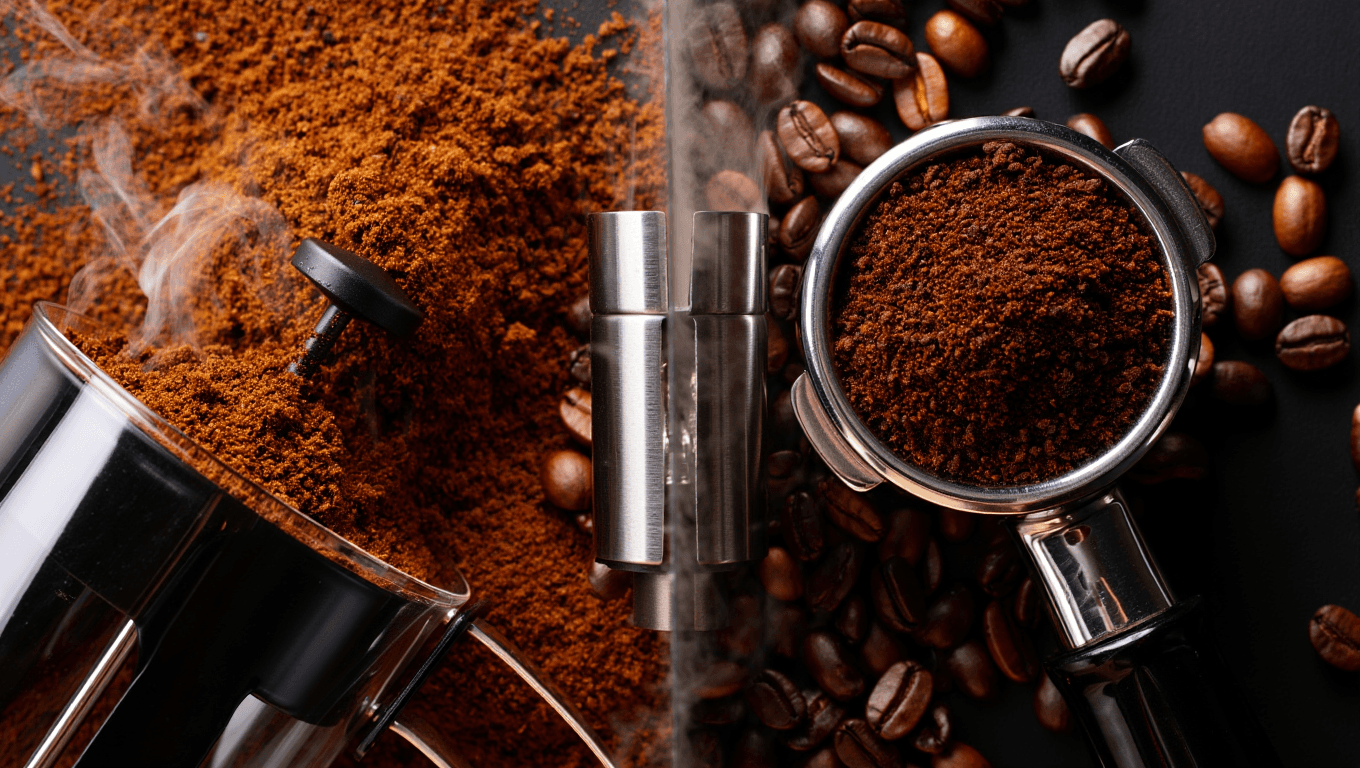
To understand the unique requirements of South Indian filter coffee, one must first look at the two polar opposites of the grinding spectrum: French Press and Espresso. A French Press requires a coarse, sea-salt-like grind because the coffee remains in contact with hot water for several minutes. A larger surface area prevents the coffee from becoming overly bitter during this long immersion. On the other end, Espresso requires an ultra-fine, flour-like grind because the water is forced through the puck at high pressure in under 30 seconds. The fine particles create the necessary resistance to build pressure and extract the creamy crema. South Indian filter coffee occupies a sophisticated middle ground. It is a gravity-drip method, but unlike a V60 or Chemex, it uses a metal tamper (the umbrella) to compress the grounds. Therefore, using an Espresso grind will lead to a "choked" filter, while a French Press grind will fail to produce the necessary "viscosity" that defines a true decoction. Achieving the perfect medium-fine balance is what allows Coffee S10 Brews to deliver that signature velvet texture in every cup.
Why does South Indian filter coffee need a specific medium-fine grind for the perfect decoction?
The "decoction" is the heart of South Indian coffee culture. Unlike Western drip coffee, which is meant to be consumed black, a decoction is a concentrate designed to be diluted with milk and sugar. This requires a high concentration of dissolved solids. A medium-fine grind—specifically one that feels like fine table salt—is ideal for the traditional stainless steel or brass filter. This size allows the water to sit on the bed of coffee just long enough to extract the deep, chocolatey notes of the Robusta and the aromatic brightness of the Arabica. If you are searching for the best South Indian filter coffee powder, you are essentially searching for a brand that has mastered this specific particle size. Coffee S10 Brews utilizes industrial-grade burr grinders to ensure that every particle is uniform. This consistency is why home-ground coffee often fails to mimic the professional taste; manual grinders often produce "fines" (micro-dust) that muddy the decoction. By controlling the grind to a professional standard, we bridge the gap between amateur home brewing and the legendary craftsmanship of South Indian coffee houses.
How does an 80:20 coffee-chicory blend affect the grinding and brewing process?
One of the most debated topics in Indian coffee circles is the use of chicory. Is chicory bad or necessary? For anyone seeking the authentic "Madras Kaapi" experience, chicory is an essential ingredient, not a filler. When you use an 80:20 coffee-chicory blend, the chicory acts as a natural "thickener." Chicory root is more soluble than coffee beans and contributes a woody, caramel-like sweetness and a significantly darker color. From a brewing perspective, chicory changes how water interacts with the coffee bed. It helps slow down the flow of water, acting almost like a natural regulator that ensures the coffee grounds are thoroughly saturated. This is a primary reason why an 80:20 coffee-chicory blend provides benefits in body and crema that a 100% Arabica blend often lacks in a traditional filter. Coffee S10 Brews specializes in this 80:20 ratio, hand-selecting premium chicory that complements our small-batch roasted beans rather than overpowering them. This ratio is the secret behind that lingering aftertaste and the dense, golden froth that sits atop a perfectly poured tumbler of coffee.
Burr vs. Blade: Which grinder is best for consistent South Indian filter coffee at home?
If you are serious about mastering the South Indian filter coffee ritual, the type of grinder you use is non-negotiable. Many households use a standard blade grinder (the kind found in most Indian mixies). However, blade grinders do not actually "grind" coffee; they shatter it. This results in an inconsistent mix of large chunks and fine dust. When you brew this mixture in a South Indian filter, the dust clogs the holes while the large chunks remain under-extracted. The result is a decoction that is simultaneously bitter and sour. A burr grinder, on the other hand, crushes the beans between two abrasive surfaces, allowing for precise control over the distance between them. This produces a uniform grind size, which is vital for the slow, 15-minute extraction process of a traditional filter. While we encourage enthusiasts to learn the art of grinding, many find that the professional, controlled roasting and grinding cycles at Coffee S10 Brews provide a level of consistency that is difficult to achieve with entry-level home equipment. Explore how grind size impacts decoction strength by comparing a pre-ground Coffee S10 Brews pack with a generic grocery store grind.
Why doesn’t my home-brewed filter coffee taste like hotel-style coffee?
This is perhaps the most common question among coffee lovers in India. "Hotel coffee" is characterized by its intense strength, heavy body, and the ability to cut through the richness of high-fat milk. The secret lies in three factors: the blend, the grind, and the temperature. Most hotels use a high-quality Robusta-heavy blend with a significant portion of chicory (often the 80:20 or 70:30 ratio) and grind it daily to a very specific medium-fine setting. They also use large commercial filters that maintain heat better than small home filters. To replicate this, you must start with a fresh, high-altitude roast like those offered by Coffee S10 Brews. Furthermore, the water temperature must be just off the boil—around 92°C to 96°C. If the water is too cool, it won't extract the oils from the chicory. If you are struggling with a weak brew, try an 80:20 blend to experience traditional depth and ensure you are tamping the powder firmly but not excessively. The goal is a steady, slow drip—one drop per second—to create that "liquor" that is the hallmark of professional South Indian coffee.
The role of chicory in grind consistency and mouthfeel
Chicory is more than just a flavor additive; it is a structural component of the South Indian filter coffee experience. Because chicory is more hygroscopic (water-absorbing) than coffee, it expands slightly when it comes into contact with moisture. In the confined space of a brass filter, this expansion helps create a pressurized environment, even without the mechanical pump of an espresso machine. This is why "Why chicory is used in South Indian coffee" is a frequent search query; people sense the difference in "mouthfeel." Coffee without chicory feels "thinner" on the palate. The 80:20 ratio used by Coffee S10 Brews is carefully calibrated to ensure that the chicory enhances the viscosity without creating a "muddy" taste. It provides the "grip" that allows the milk's sugars to bind with the coffee's bitterness, creating a harmonious balance. For those transitioning from instant coffee, the presence of chicory provides a familiar comfort but with the elevated aromatics of freshly roasted beans.
Comparing Brewing Methods and Blends
To help you navigate the complex world of coffee, we have provided comparative data to illustrate why specific choices lead to better brewing outcomes.
Table 1: Filter Coffee vs. Instant Coffee
| Feature Traditional Filter Coffee Instant Coffee | ||
| Ingredients | Freshly roasted beans & chicory | Dehydrated coffee extract |
| Preparation Time | 15-20 minutes (Decoction) | 30 seconds |
| Aroma Profile | Complex, nutty, earthy, and fresh | One-dimensional, often flat |
| Mouthfeel | Heavy, syrupy, and coating | Thin and watery |
| Health & Purity | No preservatives or processing chemicals | Highly processed |
Table 2: 100% Pure Coffee vs. 80:20 Coffee-Chicory Blend
| Metric 100% Coffee Blend Coffee S10 Brews (80:20) | ||
| Color of Decoction | Deep Brown / Translucent | Opaque Black / Dark Maroon |
| Bitterness Type | Bright, acidic, citrusy | Mellow, caramel-like, earthy |
| Milk Compatibility | Best for black coffee or light milk | Perfect for heavy, frothy milk |
| Decoction Thickness | Medium | Very High (Hotel-style) |
Table 3: Comparison of Grind Sizes for Popular Methods
| Brewing Method Ideal Grind Size Visual Comparison Extraction Time | |||
| French Press | Coarse | Sea Salt | 4 Minutes |
| South Indian Filter | Medium-Fine | Table Salt | 15-20 Minutes |
| Espresso | Fine | Powdered Sugar | 30 Seconds |
Choosing a grinder that handles the oily nature of dark roasted South Indian beans
Traditional South Indian coffee involves roasting the beans to a "Full City" or "Dark" level. This process brings the natural oils to the surface of the bean, giving them a glossy appearance. These oils are where the flavor resides, but they can be a nightmare for low-quality grinders. Oily beans tend to stick to the internal components of a grinder, leading to rancidity over time if not cleaned properly. When selecting a grinder for home use, look for stainless steel burrs that can be easily disassembled and cleaned. At Coffee S10 Brews, we use state-of-the-art temperature-controlled grinders to ensure that the heat generated during the grinding process doesn't "re-cook" these oils, which would result in a stale flavor. This is why the freshness of your coffee powder is so vital. By ordering small-batch, freshly ground coffee, you avoid the pitfalls of oil oxidation and ensure that the "aroma" searchers often talk about—that nutty, roasted smell that fills the kitchen—is present every single morning.
How to store your Coffee S10 Brews to maintain grind freshness and aroma
Once coffee is ground, its surface area increases exponentially, making it vulnerable to oxygen, light, and moisture. To preserve the "South Indian filter coffee craftsmanship" inherent in every bag of Coffee S10 Brews, storage is key. Never store your coffee in the refrigerator, as the moisture can lead to mold and the porous grounds will absorb odors from other foods. Instead, use an airtight, opaque container kept in a cool, dark cupboard. If you are buying in bulk, consider transferring a small amount to a "daily use" jar and keeping the rest sealed. Freshness is the difference between a flat, boring cup and a vibrant, sensory experience. We prioritize rapid shipping and protective packaging to ensure that the "roast date" is as close to your "brew date" as possible. Discover brewing guides from Coffee S10 Brews to learn more about how to keep your coffee tasting "just-roasted" for weeks.
Step-by-step: Using your grinder to master the traditional South Indian brass filter
If you have a home grinder and a bag of whole beans, here is how you master the technique. First, set your burrs to a medium-fine setting—just a notch coarser than espresso. For a standard 2-cup brass filter, grind approximately 20-25 grams of coffee. Add the powder to the top chamber and gently press it down with the umbrella tamper. Do not press too hard; you want to level the bed, not compact it into a brick. Pour boiling water over the tamper and let it sit. The first 5 minutes are the "bloom" phase, where gases escape and the chicory begins to swell. Over the next 10 minutes, the decoction will slowly drip into the bottom chamber. If it drips too fast, tighten your grind next time. If it doesn't drip at all, coarsen it. This ritual is what connects modern drinkers to centuries of tradition. Coffee S10 Brews is here to provide the educational resources needed to turn these steps into a daily meditation on flavor and heritage.
Frequently Asked Questions about South Indian Filter Coffee
How to brew authentic filter coffee at home if I don't have a grinder?
The easiest way is to purchase a high-quality, pre-ground 80:20 blend like Coffee S10 Brews. We ensure the grind size is perfectly calibrated for traditional metal filters, removing the guesswork from your morning routine.
Why does South Indian coffee taste stronger than regular drip coffee?
The strength comes from two factors: the use of Robusta beans (which have more caffeine and body) and the inclusion of chicory. Additionally, the slow gravity-drip method creates a concentrated decoction that is much more intense than standard black coffee.
Is chicory bad for health?
No, chicory is a natural root that has been used for centuries. It is caffeine-free and contains inulin, a type of prebiotic fiber that supports digestive health. In South Indian coffee, it is used for its flavor and texture benefits, not as a harmful additive.
What is the best ratio of decoction to milk?
A classic ratio is 1:3—one part decoction to three parts hot, frothy milk. However, if you prefer a "Strong" coffee, you can move toward a 1:2 ratio. Always add the decoction to the milk, not the other way around, to preserve the froth.
Can I use an Espresso grind in my South Indian filter?
It is not recommended. Espresso grinds are often too fine and will clog the small holes of the traditional filter, leading to a stalled brew and a bitter, over-extracted decoction.
How long does the decoction stay fresh?
For the best flavor, use the decoction within 1-2 hours. While it can be stored in the refrigerator for up to 24 hours, it will lose its volatile aromatic compounds and won't produce the same "hotel-style" experience.
Why is my decoction watery?
This usually happens if the grind is too coarse, the water wasn't hot enough, or you didn't use enough coffee powder. Ensure you are using a premium blend with the correct coffee-to-chicory ratio to ensure a thick result.
Does Coffee S10 Brews offer whole beans?
We focus on providing the perfect grind to our customers to ensure consistency, but we also believe in educating consumers on the importance of freshness and the art of the 80:20 blend.
To experience the pinnacle of South Indian coffee tradition, we invite you to explore the curated selections at Coffee S10 Brews. Whether you are looking for the perfect 80:20 blend or seeking to refine your brewing technique, our resources and products are designed to bring the authentic taste of the South into your home. Experience the difference that precision grinding and artisanal roasting can make in your daily ritual.