The Science of "Small-Batch" vs. Commercial Scale Roasting
Crack the coffee code! Explore the science of small-batch vs. commercial roasting & how Coffee S10 Brews crafts perfect South Indian filter coffee.
Why is small-batch roasting essential for authentic South Indian filter coffee?
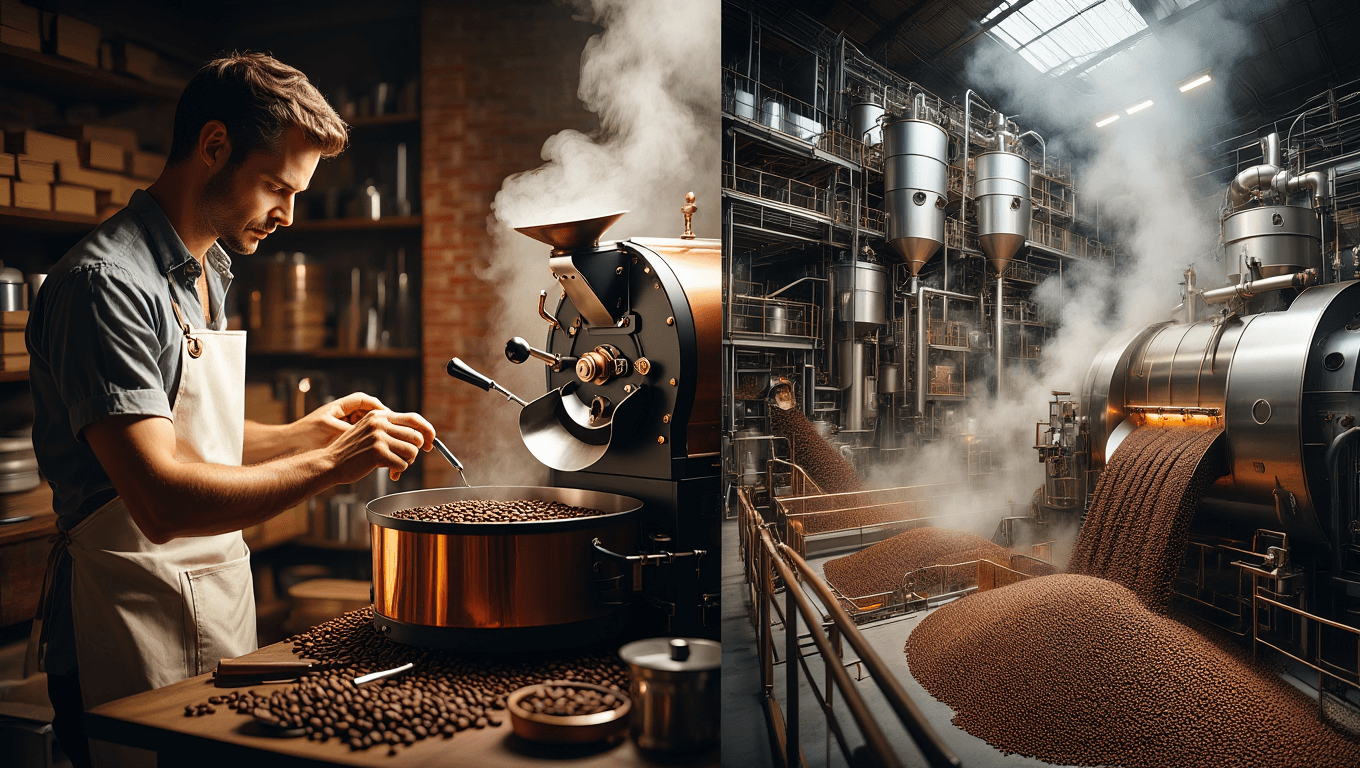
The secret to that soul-stirring cup of South Indian filter coffee—the kind that fills an entire house with its earthy, nutty aroma—lies in the physics of the roast. Small-batch roasting is a craft that prioritizes quality control over volume. In small-batch systems, typically involving 5kg to 15kg of beans, the roaster has granular control over the "Roast Curve." This refers to the precise temperature adjustments made every few seconds to ensure that the heat penetrates the center of the bean without scorching the outer oils. For South Indian filter coffee, this is critical. Because we often use a blend of Arabica and Robusta beans, each variety reacts differently to heat. Small-batch roasting allows Coffee S10 Brews to treat these beans with the respect they deserve, ensuring that the natural sweetness of the Arabica is preserved while the bold strength of the Robusta is unlocked without an ashy aftertaste.
How does the science of heat transfer differ in commercial coffee production?
In large-scale commercial roasting, the goal is throughput. Massive drums roasting hundreds of kilograms at once rely heavily on high-velocity hot air and extreme temperatures to move the product quickly. This "flash roasting" often leads to uneven development; the outside of the bean may appear dark, but the internal cellular structure remains underdeveloped. This is a primary reason why many mass-market coffees taste "flat" or overly bitter. In contrast, the small-batch approach used by Coffee S10 Brews utilizes a balance of conduction and convection. By allowing the beans to develop slowly, we facilitate the Maillard reaction—the chemical reaction between amino acids and reducing sugars that gives coffee its complex flavor profile. When you search for the "best South Indian filter coffee powder," you are essentially looking for the results of this precise chemical dance, which commercial scales simply cannot replicate.
Why the 80:20 coffee-chicory blend requires small-batch precision
One of the most common questions from coffee enthusiasts is, "Why is chicory used in South Indian coffee?" While historically it was a filler, in the hands of a master blender, it is a functional ingredient that enhances body and crema. However, chicory is far more sensitive to heat than coffee beans. In a commercial setting, chicory and coffee are often treated as a monolith, leading to a burnt, medicinal flavor. Coffee S10 Brews employs a signature 80:20 coffee-chicory blend where the coffee is roasted to a specific medium-dark profile before being expertly integrated with high-grade roasted chicory. This 80:20 ratio is the "golden mean" of South Indian tradition. The 20% chicory acts as a catalyst, thickening the decoction and providing that deep, chocolatey hue that defines a traditional "Hotel-style" coffee. Small-batch processing ensures that the chicory never overpowers the delicate notes of the handpicked coffee beans.
Understanding the impact of roast uniformity on filter coffee extraction
If you have ever wondered, "Why doesn’t my filter coffee taste like hotel coffee?" the answer often comes down to extraction uniformity. When beans are roasted in massive commercial batches, the roast level varies across the pile. Some beans are over-roasted, others under-roasted. When ground, these inconsistent beans extract at different rates. The over-roasted ones provide bitterness, while the under-roasted ones provide a sour, grassy note. Small-batch roasting ensures a 99% uniformity rate. This means that when you use your traditional brass filter or a modern drip maker, every granule of Coffee S10 Brews releases its flavor at the same time. This consistency is what allows for a thick, syrupy decoction that can stand up to the addition of hot, frothy milk without losing its character.
Small-Batch vs. Commercial Scale Roasting: A Comparison
| Feature Small-Batch (Coffee S10 Brews) Commercial Scale (Mass Market) | ||
| Heat Control | Precision-monitored roast curves | High-heat flash roasting |
| Flavor Profile | Complex, sweet, nutty, and balanced | One-dimensional, often bitter or burnt |
| Bean Integrity | Handpicked, uniform bean development | Variable bean quality and uneven roast |
| Freshness | Roasted in cycles based on demand | Sits in warehouses for months |
| Chicory Integration | 80:20 blend optimized for body and aroma | Chicory often used to mask low-grade beans |
Why does South Indian coffee taste stronger than Western styles?
The perception of "strength" in South Indian coffee is a combination of bean selection, roast depth, and the inclusion of chicory. Western coffee, like a light-roast Pour Over, focuses on acidity and floral notes. However, the South Indian palate craves "body"—the physical weight of the liquid on the tongue. By using small-batch roasting to achieve a dark-medium profile, we caramelize the sugars within the bean to their maximum potential. This creates a "heavy" mouthfeel. When combined with the 80:20 blend benefits, the resulting decoction is incredibly dense. This is why South Indian filter coffee feels more substantial than a standard Americano. Coffee S10 Brews masters this by ensuring the roast stops exactly at the "second crack"—the moment when the oils just begin to migrate to the surface, providing that signature shine and intense aroma.
The role of degassing and freshness in South Indian coffee aroma
Freshness is a non-negotiable pillar of coffee science. Immediately after roasting, coffee beans begin to release Carbon Dioxide (CO2) in a process called degassing. If a coffee is packed too early, the gas builds up; if it is packed too late, the volatile aromatic compounds—those that give coffee its "fresh" smell—evaporate. Commercial brands often vacuum-seal coffee that was roasted weeks or months prior, leading to a stale, cardboard-like taste. At Coffee S10 Brews, our small-batch philosophy extends to our packaging timeline. We manage our roasting cycles to ensure that the coffee reaching your doorstep has just finished its peak degassing phase. This ensures that when you open a bag of our 80:20 blend, the aroma is potent enough to fill the room, a hallmark of truly authentic South Indian filter coffee.
Comparing the 100% Coffee Blend vs. the 80:20 Coffee–Chicory Blend
| Attribute 100% Pure Coffee 80:20 Coffee–Chicory Blend | ||
| Decoction Thickness | Thin, tea-like consistency | Thick, syrupy, and viscous |
| Aroma Type | Fruity, acidic, and bright | Earthy, nutty, and caramelized |
| Interaction with Milk | Can become diluted or "watery" | Holds its own; creates a rich, creamy cup |
| Best Used For | Black coffee, Espresso, AeroPress | Traditional South Indian Filter Coffee |
| Crema/Froth | Light and dissipates quickly | Stable, thick "Hotel-style" froth |
How to brew authentic filter coffee at home using small-batch powder
To honor the science behind the roast, your brewing technique must be equally precise. Start with a traditional stainless steel or brass coffee filter. Add 2-3 tablespoons of Coffee S10 Brews 80:20 blend to the upper compartment. Lightly press the powder with the plunger—do not compress it too hard, or the water won't pass through; do not leave it too loose, or the water will gush through without extracting flavor. Pour "just-off-the-boil" water over the plunger and let it sit for 15 to 20 minutes. The result is a potent, thick decoction. This slow-drip method is the only way to capture the full spectrum of flavors developed during the small-batch roasting process. Explore our brewing guides from Coffee S10 Brews to master the art of the perfect pour, ensuring you get that frothy "top" every single time.
The sensory descriptors of a perfect South Indian roast
When evaluating your coffee, look for these markers of quality that only small-batch roasting can provide. First is the Aroma: it should be reminiscent of roasted nuts and dark chocolate, not burnt rubber. Second is the Body: it should feel velvety on the palate. Third is the Crema: even in a filter decoction, a thin layer of golden-brown bubbles should form at the top. Finally, the Aftertaste: a high-quality 80:20 blend will leave a lingering sweetness, a far cry from the harsh, dry finish of commercial instant coffees. At Coffee S10 Brews, we meticulously sample every batch to ensure these sensory benchmarks are met, providing a level of reliability that mass-market brands simply cannot offer.
Filter Coffee vs. Instant Coffee: Why the Roast Matters
| Metric South Indian Filter Coffee (S10 Brews) Instant Coffee (Commercial) | ||
| Processing | Slow-roasted, ground beans | Dehydrated coffee extract (factory processed) |
| Chemical Additives | Zero; 100% natural ingredients | Often contains stabilizers or preservatives |
| Flavor Depth | Multidimensional (Nutty, Sweet, Bold) | Flat, acidic, and chemical notes |
| Antioxidant Content | High; preserved through careful roasting | Lower due to extreme industrial processing |
| Ritual & Experience | An authentic, sensory-rich tradition | A quick, utility-based caffeine fix |
Common FAQs About South Indian Filter Coffee Science
1. Why is chicory used in South Indian coffee blends?
Chicory is used to increase the thickness (viscosity) of the decoction and to add a deep, woody flavor that complements the milk. It also helps in retaining heat and creating a better froth. In an 80:20 blend, it balances the caffeine kick with a smooth finish.
2. Does small-batch coffee stay fresh longer?
Actually, all coffee starts losing flavor after roasting. However, small-batch brands like Coffee S10 Brews roast on demand, meaning the coffee arrives at your home much sooner after the roast date than commercial brands, giving you a longer "freshness window."
3. Is an 80:20 coffee-chicory blend better than 70:30?
The 80:20 blend is widely considered the premium standard. It provides enough chicory to give the coffee "body" without masking the high-quality notes of the coffee beans. A 70:30 blend is often used in commercial settings to lower costs, resulting in a more bitter taste.
4. Why does my filter coffee taste bitter?
Bitterness is usually caused by over-extraction (leaving the water in the filter too long) or by using coffee that was roasted at too high a temperature in a commercial roaster. Using a precise small-batch roast from Coffee S10 Brews significantly reduces this risk.
5. Can I use filter coffee powder in an Espresso machine?
While you can, the grind size for South Indian filter coffee is specifically calibrated for a slow-drip process. For the best results, stick to the traditional filter or a French Press to experience the intended flavor profile of our 80:20 blend.
6. What is the "Maillard Reaction" in coffee?
It is a chemical reaction between sugars and proteins that occurs during roasting. It is responsible for the brown color and the complex, savory-sweet flavors in the coffee. Small-batch roasting allows this reaction to happen evenly throughout the bean.
7. Why is the aroma of Coffee S10 Brews so strong?
Our strength comes from our handpicked beans and our controlled roasting cycles that prevent the delicate aromatic oils from being burnt away, which is common in mass-scale production.
Embrace the Craftsmanship of Coffee S10 Brews
The journey from a raw green bean to the perfect frothy tumbler of filter coffee is paved with scientific precision. By choosing small-batch roasting, you are not just buying coffee; you are investing in a tradition of excellence that values flavor over volume. Coffee S10 Brews is dedicated to bringing this authentic South Indian experience to your kitchen. Whether you are a seasoned connoisseur or a curious beginner, our signature 80:20 blend offers the consistency, aroma, and depth you’ve been searching for. Explore our range of premium blends and discover brewing guides that will transform your morning ritual into a masterpiece of Indian coffee culture.