Why Every Home Setup Needs a "WDT" Tool for Better Extraction
Unlock richer flavour in your daily brew! Discover why a WDT tool is essential for perfect, even coffee extraction in your home setup. Elevate your Coffee S10 ritual.
Why is my home-brewed filter coffee inconsistent compared to hotel-style coffee?
Many coffee enthusiasts in India face the same frustration: despite buying the best South Indian filter coffee powder, the decoction at home often turns out watery, sour, or lacking that "kick" found in legendary Darshinis or traditional households. The culprit isn't necessarily the beans, but rather a phenomenon called "channeling." When coffee grounds are packed into a traditional brass filter, they often contain tiny clumps created during the grinding or storage process. When hot water is poured over these grounds, it seeks the path of least resistance. Instead of saturating every particle of coffee, the water rushes through gaps between clumps, leaving a significant portion of the coffee dry and unextracted. This results in a weak decoction that fails to carry the full-bodied richness intended by the roaster. Achieving that elusive hotel-style consistency requires more than just high-quality beans; it requires a commitment to uniform distribution, which is where the WDT tool becomes an essential part of the modern South Indian coffee ritual.
What is a WDT tool and why does it matter for South Indian filter coffee?
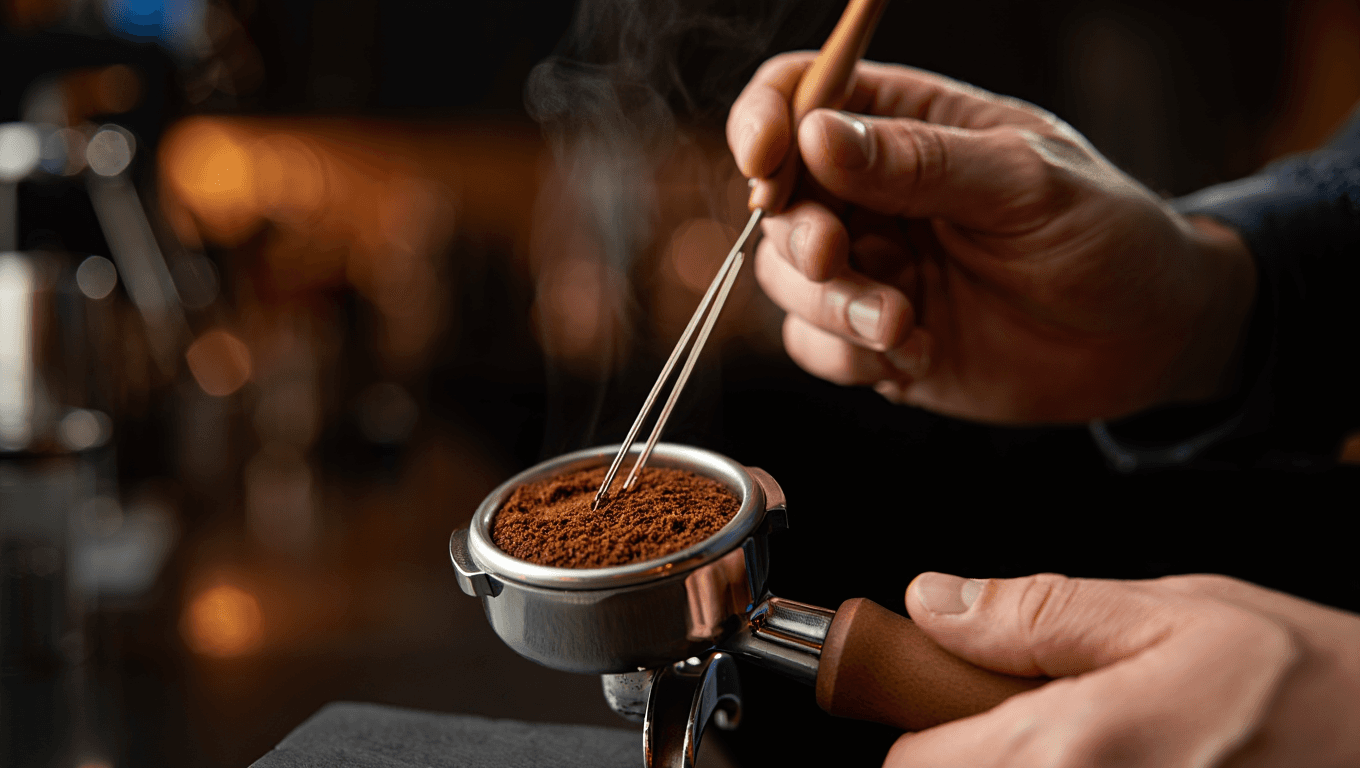
The Weiss Distribution Technique (WDT) tool is a simple yet revolutionary device consisting of several fine needles used to stir coffee grounds. While originally designed for espresso, its application in South Indian filter coffee is transformative. In the context of the traditional filter, the WDT tool serves to break up clumps and homogenize the bed of coffee before you use the plunger (the "umbrella" or press). When using a premium blend like the Coffee S10 Brews signature 80:20 coffee-chicory mix, the fine grind necessary for a slow-drip decoction is highly prone to static and clumping. By using a WDT tool, you ensure that the density of the coffee bed is uniform across the entire diameter of the filter. This level of precision distribution allows the water to descend at an even rate, extracting the deep chocolatey notes and the earthy richness of the chicory consistently every single morning.
How does clumping in coffee grounds affect the strength of your decoction?
To understand why clumping is the enemy of a perfect cup, we must look at the physics of extraction. Coffee S10 Brews focuses on a specific grind profile that balances surface area with water flow. However, when grounds clump together, they create high-density pockets and low-density voids. In the voids, the water flows too quickly (under-extraction), resulting in a thin, acidic liquid. Inside the dense clumps, the water may not penetrate at all, wasting the precious oils and aromatics trapped within. For a South Indian filter coffee to achieve its signature "syrupy" consistency, every grain must contribute. Using a WDT tool eliminates these density variations. By raking the needles through the grounds in your brass filter, you create a fluffy, even texture that encourages the water to dwell just long enough to pull out the maximum TDS (Total Dissolved Solids). This is how you bridge the gap between a "thin brown liquid" and a "thick, viscous decoction."
Why an 80:20 coffee-chicory blend requires better distribution than instant coffee?
Instant coffee is a processed, dehydrated extract that dissolves immediately in water, requiring zero technique. In contrast, authentic South Indian filter coffee is a craft. The addition of chicory—specifically in the optimized 80:20 ratio championed by Coffee S10 Brews—changes the physical behavior of the grounds. Chicory is more hygroscopic than coffee, meaning it absorbs moisture from the air more readily. This can make the powder slightly "stickier" than a 100% Arabica blend. This stickiness increases the likelihood of clumps forming the moment you scoop the powder into your filter. Without a WDT tool to break these bonds, the water might struggle to penetrate the chicory-rich areas, leading to an unbalanced flavor. Proper distribution ensures that the chicory enhances the body and provides that beautiful reddish-brown tint and lingering sweetness without overpowering the delicate aromatics of the handpicked coffee beans.
The science of extraction: How WDT tools prevent channeling in traditional brass filters
Traditional South Indian filters rely on gravity-fed percolation. Unlike espresso machines that use 9 bars of pressure, the only force moving water through your filter coffee is the weight of the water itself. This makes the "permeability" of the coffee bed even more critical. If one side of the filter is packed more densely than the other, the water will tilt its flow toward the looser side. This "channeling" is the primary reason why your second or third pour might taste vastly different from your first. By integrating a WDT tool into your brewing intelligence routine, you are essentially engineering a "perfect" filter bed. The needles reach the bottom of the top compartment, ensuring that the foundation of the coffee is as aerated as the surface. This leads to a slow, steady drip that maximizes contact time, allowing the Coffee S10 Brews roast profile to fully express its sensory descriptors of toasted nuts and dark caramel.
Comparing the results: WDT vs. traditional tamping in South Indian coffee brewing
For decades, the standard advice has been to "lightly press" the coffee with the included plunger. While tamping is necessary to create resistance, tamping over clumps only compresses the problem. If you press down on a clumped bed of coffee, you create a "puck" with permanent structural flaws. The WDT tool should always precede the press. Think of it as the "preparation" and the plunger as the "setting." When you use the WDT tool first, the plunger meets a perfectly level surface. This results in a decoction that is noticeably darker, thicker, and more aromatic. For the serious home brewer, this small addition to the workflow makes the difference between a mediocre cup and a brand-authoritative experience that rivals the most famous coffee houses of Mylapore or Malleshwaram.
Understanding the nuances of coffee distribution and extraction
| Feature Instant Coffee 100% Coffee (No WDT) 80:20 Blend (With WDT) | |||
| Body/Texture | Thin and watery | Medium, often inconsistent | Heavy, syrupy, and "Hotel-style" |
| Aroma Profile | Flat, artificial | Bright but can be sour | Complex, nutty, and lingering |
| Extraction Consistency | High (Chemical) | Low (Prone to channeling) | Very High (Mechanical precision) |
| Role of Chicory | None | N/A | Enhanced crema and mouthfeel |
Does the grind size of South Indian filter coffee demand specialized distribution tools?
The grind size for South Indian filter coffee is a specific "medium-fine" or "fine" setting—coarser than espresso but much finer than a French Press. This specific micron range is chosen to facilitate a 15–20 minute drip time. At this fineness, static electricity during the grinding process is inevitable. Static causes individual coffee particles to cling together in "micro-clumps." While these may look like a smooth powder to the naked eye, they act like boulders to a water molecule. By using a WDT tool, you are performing "mechanical declumping." This ensures that the fine particles of the Coffee S10 Brews blend are distributed evenly, allowing for a uniform "bloom" when the first splash of hot water hits the grounds. Exploring how grind size impacts decoction strength is a journey every coffee lover should take, and the WDT tool is the most effective compass for that journey.
How to use a WDT tool with your Coffee S10 Brews for the perfect hotel-style coffee
To master the South Indian filter coffee ritual at home, follow these steps: First, add 4–5 heaped tablespoons of Coffee S10 Brews 80:20 powder into the top compartment of your brass or stainless steel filter. Before reaching for the plunger, take your WDT tool and stir the grounds in a circular and vertical motion. Ensure the needles reach the bottom to break up any hidden air pockets. Once the powder looks "fluffy" and level, use the plunger to gently even out the surface—do not press too hard, as the WDT has already optimized the density. Pour freshly boiled water (around 92-96°C) over the back of the plunger to avoid disturbing the bed. Cover with the lid and wait for 15 minutes. The resulting decoction will have a depth of flavor and a natural sweetness that eliminates the need for excessive sugar, highlighting the small-batch roasting expertise inherent in every S10 pack.
Enhancing the sensory experience: Aroma, body, and crema through precision distribution
The sensory experience of South Indian filter coffee is defined by three pillars: the "Aroma" that fills the kitchen, the "Body" (the weight of the coffee on the tongue), and the "Crema" (the frothy layer created when mixing with hot milk). Poor distribution through lack of a WDT tool kills all three. Channeling causes the water to miss the aromatic oils, leading to a flat scent. It results in a thin body because the soluble solids aren't fully extracted. Finally, the "frothiness" of the final cup depends on the proteins and fats extracted from the coffee bean; an uneven extraction means fewer of these compounds make it into the Davara. When you use a WDT tool with an 80:20 blend, you maximize the release of these compounds. This is why Coffee S10 Brews advocates for "Brewing Intelligence"—it’s about using modern tools to honor and elevate traditional flavors.
Why modern accessibility meets traditional craftsmanship in your kitchen
The beauty of the WDT tool is its simplicity. It represents the bridge between modern coffee science and traditional South Indian craftsmanship. While our grandparents might have used a finger or a spoon to level the coffee, the WDT tool offers a level of precision that was previously unavailable to the home brewer. At Coffee S10 Brews, we believe that tradition should evolve with better tools. By combining our handpicked, small-batch roasted beans with precise distribution techniques, you are not just making coffee; you are preserving a culture. This approach ensures that the freshness and consistency we build into our roasting process are actually realized in your cup. It makes the ritual easier, the results more predictable, and the coffee significantly more enjoyable.
Is chicory bad or necessary for that authentic "Strong" taste?
A common question among modern coffee drinkers is whether chicory is a "filler" or a "functional" ingredient. In the context of South Indian coffee culture, chicory is essential. It performs two roles: it slows down the extraction, allowing the water more time to absorb the coffee's flavor, and it adds a bittersweet depth that balances the acidity of the beans. However, the ratio is critical. An 80:20 blend is widely considered the "Golden Ratio." It provides enough chicory to create that thick, velvet-like mouthfeel without masking the high-quality notes of the coffee. When you use a WDT tool, you ensure that the coffee and chicory are perfectly interspersed. This prevents "chicory-heavy" sips that can be overly bitter and ensures a harmonious balance. Try an 80:20 blend from Coffee S10 Brews to experience this traditional depth in its most refined form.
Frequently Asked Questions about South Indian Filter Coffee and WDT Tools
1. Why does my filter coffee taste bitter even with an 80:20 blend?
Bitterness often comes from over-extraction caused by water sitting too long in the filter, or from "channeling" where water extracts too much from a small path. A WDT tool ensures even flow, while using water just off the boil (not boiling) prevents scorching the delicate grounds.
2. Can I use a WDT tool with any type of coffee powder?
Yes, but it is most effective with finely ground coffee used for espresso or South Indian filter coffee. For coarser grinds like Cold Brew, clumping is less of an issue, but for the fine grind of Coffee S10 Brews, it is a game-changer.
3. How long should I stir the coffee grounds with a WDT tool?
You only need about 10–15 seconds of stirring. The goal is to see a level, fluffy bed of coffee with no visible lumps before you apply the plunger.
4. Does a WDT tool replace the need for a coffee plunger/press?
No, the WDT tool and the plunger work together. The WDT distributes the coffee evenly, and the plunger provides the necessary flat surface for the water to sit on, ensuring it doesn't create a "crater" in the coffee bed when poured.
5. Why is Coffee S10 Brews specifically recommended for this technique?
Our beans are roasted in small batches to ensure uniform moisture content and grind consistency. This makes them highly responsive to precision tools like the WDT, allowing the home brewer to replicate the exact flavor profile our roasters intended.
6. What is the best way to clean a WDT tool?
Since it only touches dry coffee grounds, a simple wipe with a dry cloth or a quick brush-off is all that's needed. Keep the needles straight to ensure they continue to provide even distribution.
Master the art of the perfect brew with Coffee S10 Brews
The journey to the perfect cup of South Indian filter coffee is one of constant refinement. By understanding the science of distribution and the role of the WDT tool, you move one step closer to mastering the ritual. Don't settle for inconsistent, watery coffee when the "cure" is as simple as better preparation. Explore our range of premium blends, designed specifically for those who value authenticity, craftsmanship, and the perfect morning decoction. Whether you are a seasoned connoisseur or a curious beginner, our resources are here to guide you toward coffee excellence.
- Discover our signature 80:20 Coffee-Chicory blends for the ultimate hotel-style taste.
- Explore our detailed brewing guides to refine your home setup.
- Learn more about the heritage and science of South Indian coffee culture on our education hub.